
The Ultimate Guide to Hiring a Luxury Destination Wedding Photographer in 2026
- Maiyan Studios
- May 20
- 12 min read
If your chosen professional attempts to enter Mexico as a "wedding guest" with a suitcase full of cameras in 2026, your wedding gallery could end before the first dance due to an unexpected deportation. Hiring a destination wedding photographer for a luxury celebration is no longer just about finding a beautiful portfolio; it's about hiring a logistical architect who understands international law as well as they understand lighting. You want every sacred ritual and sunset toast captured perfectly, but the anxiety of gear safety and hidden travel fees can easily overshadow your excitement.
We understand that you're looking for a seamless experience that honors your heritage and your location. This guide will help you master the complex logistics of global event coverage and explain why cultural fluency is the key to capturing high-end celebrations. You'll learn how to navigate the latest 2026 travel regulations, the importance of multi-day coverage for South Asian weddings, and how to secure a contract that guarantees magazine-quality cinematography and photography without the stress.
Key Takeaways
Learn why your photographer is your most vital vendor and how to verify their gear redundancy for remote international locations.
Master the logistics of multi-day South Asian wedding coverage to ensure every ritual, from the Sangeet to the ceremony, is documented with precision.
Discover how to vet a destination wedding photographer by analyzing their past international experience and travel fee transparency.
Weigh the benefits of local venue knowledge against the stylistic consistency and cultural fluency of an imported creative team.
Understand how to integrate professional wedding cinematography and photography for a seamless, magazine-quality narrative of your celebration.
Table of Contents
Why Your Destination Wedding Photographer is Your Most Critical Hire
Your florist leaves after the centerpieces are set. Your caterer departs once the cake is cut. However, your destination wedding photographer is the only vendor who remains by your side from the first sunrise ritual to the final sparkler exit. This constant presence makes them the most critical hire for your 2026 celebration. They aren't just taking pictures; they're managing the visual legacy of your family in a location that might be thousands of miles from home. When you're hosting a multi-day event, this professional becomes your shadow, capturing the quiet moments between the grand ceremonies.
High-end destination events demand more than just artistic talent. They require a logistical specialist who travels with multiple camera bodies, various lenses, and redundant backup systems. If a piece of equipment fails in a remote villa in Tuscany or a beach resort in Mexico, there's no local shop to visit for a quick replacement. A true professional understands that destination wedding photography involves significant risk management. They bring the expertise to handle gear safety and data protection in transit, ensuring your memories are secure before they ever leave the venue. This is what separates a simple travel photographer from a dedicated specialist.
The Role of a Visual Storyteller Abroad
Luxury weddings in 2026 are moving toward a more cinematic, narrative-driven style. It's about more than just "pretty pictures"; it's about creating a cohesive story that feels like a film. This is why many couples prioritize wedding cinematography alongside photography. A specialist knows how to manage unique lighting challenges, such as the harsh midday sun of the Amalfi Coast or the complex indoor lighting of a historic European ballroom. They use light to build a mood that reflects the heritage of the couple and the beauty of the destination.
Defining Luxury in a Global Context
Luxury coverage goes beyond standard travel packages. It includes a high level of personalized service and technical mastery. One way to ensure a seamless experience is through a pre-wedding shoot or an engagement session in your destination city. These sessions allow you to build rapport with your photographer and get comfortable in front of the lens before the main events begin. If you're looking for inspiration, you can explore various engagement photo ideas that utilize the unique architecture and landscapes of your chosen location. This preparation ensures that when the wedding day arrives, the process feels natural and stress-free.
Managing Multi-Day Logistics for South Asian Destination Weddings
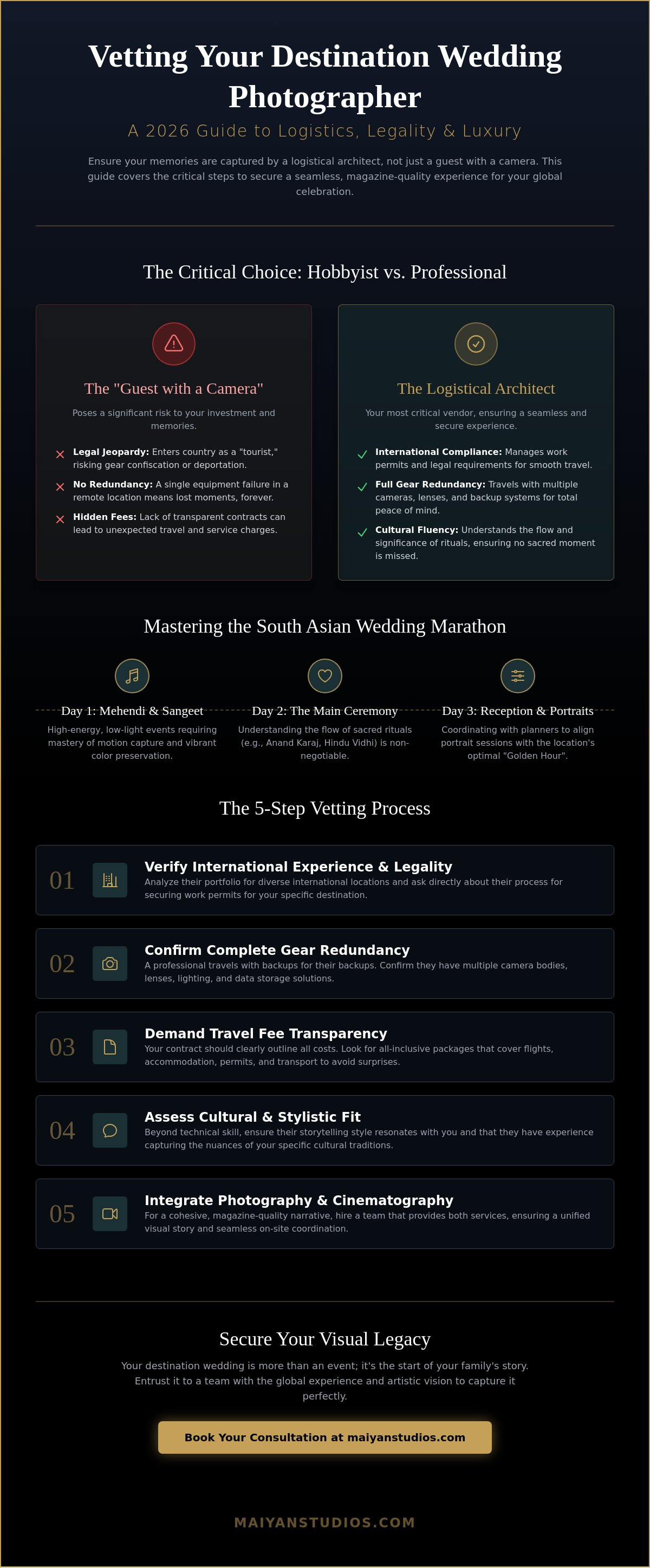
South Asian celebrations are rarely one-day affairs. In the luxury market, these events often span a full "wedding week," requiring a destination wedding photographer to act as a marathon runner rather than a sprinter. The logistics of a three-day model, covering the Mehendi, Sangeet, and the Main Ceremony, demand a level of endurance and planning that standard wedding packages simply don't address. Each day features distinct lighting requirements and emotional arcs that must be preserved to tell a complete story. It isn't enough to just show up; the creative team must understand the specific flow of an Anand Karaj or a Hindu Vidhi to ensure no sacred ritual is missed.
Timing is everything when you're working across different latitudes. The "Golden Hour" in a tropical location like the Riviera Maya happens quickly, while a summer wedding in Lake Como might offer a sunset that lingers for hours. A professional team coordinates with local planners months in advance to ensure the itinerary aligns with the best natural light. This is especially vital for late-night rituals, where specialized lighting equipment is necessary to capture the ceremony without destroying the venue's natural ambiance. For those just starting their search, reviewing a guide to hiring a destination wedding photographer can provide a foundational understanding of the vetting process for these complex needs.
Capturing the Sangeet and Jago Night
The Sangeet and Jago nights are high-energy events that often take place in low-light ballrooms or outdoor courtyards. Your photographer needs to be a master of motion, capturing synchronized dances and spontaneous joy without losing the vibrancy of South Asian colors in the edit. Preserving the deep fuchsias, rich marigolds, and intricate henna patterns requires a sophisticated post-production workflow. It's about visualizing the scale of the guest list, which often exceeds the destination average of 39 people, and ensuring the energy of the room translates to the final gallery. If you're planning a multi-city celebration, our destination wedding coverage is designed to handle these exact high-pressure environments.
The Logistics of Ritual Continuity
Ritual continuity is the backbone of a successful multi-day shoot. A dedicated team ensures that key family members are identified early and documented across every event to respect cultural hierarchy. This requires a rigorous shot list and a system for managing gear in international locations. Between ceremonies, the team must handle data backups and equipment charging, often in regions with different power standards. There's no room for error when a ceremony starts at dawn; the team must be ready with cleared memory cards and fresh batteries every single day.
Local vs. Imported Photographers: Making the Right Choice
Deciding between a local professional and an imported destination wedding photographer is a pivotal choice in the planning process. Local vendors offer a "local advantage" that usually includes intimate venue knowledge and the elimination of airfare or lodging expenses. However, luxury clients often find that the "import advantage" provides something far more valuable: total stylistic consistency and cultural fluency. When you fly in a team you've vetted personally, you're ensuring that the person behind the lens understands your vision, your language, and your family dynamics before they even step off the plane.
The hidden costs of hiring local frequently emerge in the form of communication barriers or differing stylistic standards. A photographer based in a remote destination might have a portfolio that looks beautiful, but their editing style or approach to posing may not align with the editorial, cinematic look popular in 2026. It's also vital to understand the costs of a traveling photographer to see how those fees translate into a seamless experience. For high-stakes celebrations, the peace of mind that comes with a trusted team often outweighs the logistical effort of bringing them to the location.
Evaluating a portfolio for a destination event requires a keen eye for skin tone accuracy and lighting versatility. You need to see how a photographer handles the bright, reflective light of a beach resort compared to the dim, moody interior of a historic European castle. If the portfolio only shows one type of lighting, they may struggle when faced with the unpredictable conditions of a foreign landscape. A diverse portfolio is the best indicator that a team can deliver magazine-quality results regardless of the geographical challenges.
The Cultural Fluency Factor
Knowing when a ritual happens is often more important than knowing where the best sunset spot is located. An imported team that specializes in your specific heritage understands the emotional weight of every blessing and the sequence of every ceremony. They don't need to be told where to stand during a crucial religious moment; they already anticipate the movement. This cultural shorthand allows you to remain present in the moment rather than acting as a guide for your vendors.
Style Consistency Across Borders
The biggest risk of hiring a local firm is the "outsourced" shooter model, where a studio sends a freelancer you've never met. By bringing your own dedicated team, you guarantee that the lead creative who captured your engagement session is the same person documenting your wedding day. This continuity is essential for destination harmony, especially when you have a unified photo and video team working together. It prevents conflicting personalities from cluttering your space and ensures your final gallery and film feel like a single, cohesive work of art.
5 Essential Steps to Vetting Your Destination Photographer
Vetting a destination wedding photographer requires a much deeper level of scrutiny than hiring a local professional. You aren't just looking for an artist; you're looking for a traveler who understands international law and technical endurance. Before signing a contract, you must verify their experience in your specific region. A photographer who excels in a controlled studio environment might struggle with the intense humidity of the Riviera Maya or the rapidly changing light of the Swiss Alps. Ask to see full galleries from weddings shot in similar climates to ensure they can produce consistent results under pressure.
Legal compliance is a critical but often overlooked step. As of May 2026, many popular destinations have strict regulations for foreign creatives. For instance, if you're planning a wedding in Mexico, your photographer must obtain an FM3 work visa, a process that takes four to six weeks. Attempting to enter as a "wedding guest" with professional gear carries a significant risk of detention or deportation. Similarly, working on a standard tourist visa in Europe's Schengen Area is illegal. Ensure your team is committed to following these legal frameworks to avoid a disaster on your wedding day.
Finally, assess their "One Team" capability. Managing two separate companies for photo and video in a foreign country doubles your logistical headache and travel costs. Choosing a studio that provides both wedding photography and wedding cinematography ensures a unified aesthetic and a smaller, more efficient footprint at your venue. This collaboration prevents vendors from competing for the same shots and creates a more relaxed environment for you and your guests.
Understanding the Contract and Travel Clause
A professional destination contract should be exhaustive. It must clearly outline who is responsible for flights, lodging, and ground transport. Look for a "Force Majeure" clause that specifically addresses international travel issues like flight cancellations or border closures. You should also confirm the travel fee structure. Some photographers offer all-inclusive rates, while others may bill for "per diem" costs or unexpected transport fees. Knowing these details upfront prevents budget creep during the final weeks of planning.
Gear and Technical Redundancy
Equipment failure in a remote location can be catastrophic. A prepared professional follows the "Two-Body" rule, meaning they carry at least two high-end camera bodies at all times. They should also have a clear strategy for data redundancy. This usually involves cameras that write to two memory cards simultaneously and a system for backing up files to both physical drives and the cloud while on the move. Don't forget to ask about their technical preparation for the region, including voltage adapters and specialized lighting modifiers that can withstand the local environment.
Maiyan Studios: Global Storytelling for the Modern Couple
Your search for a destination wedding photographer should end with a partner who values your legacy as much as you do. At Maiyan Studios, our philosophy centers on blending cinematic excellence with deep cultural respect. We specialize in luxury weddings where the narrative is complex and the stakes are high. One of our greatest advantages for international events is our integrated Photo and Cinema team. By providing both wedding photography and wedding cinematography under one roof, we eliminate the friction often caused by separate vendors competing for the same space. This synergy allows for a smaller, more discreet presence that still captures every angle of your celebration.
Our 2026 destination wedding coverage is designed specifically for the multi-day nature of modern luxury events. We don't just provide a few hours of coverage; we prioritize a seamless experience that spans your entire itinerary. From initial site visits where we scout the best lighting to the final delivery of handcrafted fine-art albums, we manage every detail. This comprehensive approach ensures that the visual story of your wedding remains consistent. Whether we're shooting a pre-wedding session in Paris or the main ceremony in Dubai, the quality never wavers.
Our Global Portfolio and Experience
We've successfully documented love stories across Europe, Asia, and the Americas, adapting to the unique environmental and lighting challenges of each continent. Our team is particularly committed to capturing the vibrant emotions and intricate rituals of South Asian weddings. We understand that these moments aren't just events; they're the continuation of a heritage. We prepare for your specific 2026 destination by researching local customs and logistical requirements months in advance. This ensures we're ready for the unique challenges of your chosen venue long before the first guest arrives.
Securing Your 2026 Destination Date
To maintain our high standard of service and artistic quality, we limit the number of destination commissions we accept each year. This allows us to focus entirely on your celebration, from the initial concept development to the final frame. Our consultation process is designed to align our creative vision with your personal style, ensuring a stress-free experience from start to finish. If you're ready to begin planning your visual legacy, reach out to secure your place on our calendar. Legacy matters. We're here to capture it.
Secure Your Visual Legacy Across the Globe
Choosing the right destination wedding photographer is the most significant decision you'll make for your 2026 international celebration. Success lies in vetting for legal work permits and prioritizing a team that understands the intricate flow of multi-day cultural rituals. By focusing on these logistical and artistic priorities, you can move forward with the confidence that your wedding will be documented with precision and respect. You deserve a creative team that acts as a partner in your planning, ensuring that every sacred moment is preserved regardless of the time zone or terrain.
Maiyan Studios specializes in the complex logistics of high-end luxury events. Our integrated photo and cinema teams are experts in capturing the vibrancy of South Asian celebrations across the globe. We handle the technical challenges of international travel so you can stay present in every moment. Your adventure is just beginning, and we're ready to capture every frame of your journey.
Plan Your Luxury Destination Wedding with Maiyan Studios
Frequently Asked Questions
How much do destination wedding photographer travel fees typically cost?
Travel fees typically encompass airfare, accommodation, ground transportation, and daily meal stipends for the team. Most professionals prefer to quote an all-inclusive travel fee or a flat rate to prevent any billing surprises after the wedding. This ensures the destination wedding photographer can manage their own logistics while staying within your pre-approved budget. You should clarify in your contract whether these fees are due at the time of booking or as part of the final payment.
Should I book the photographers flights and hotel, or should they?
It's generally better for the photographer to book their own travel and invoice you for the costs. This allows them to choose flight times that provide a buffer for potential delays and select hotels that offer the necessary security for their professional equipment. If you choose to book for them, ensure the accommodation is at the same venue or very close by to avoid transport delays during the wedding events.
Do destination wedding photographers bring their own lighting equipment?
Yes, a luxury professional will bring a portable lighting kit designed for international travel. This often includes high-end off-camera flashes, LED panels, and compact light modifiers that can be used in both bright outdoor settings and dark indoor ballrooms. They don't rely on the venue's existing light, especially for high-stakes ceremonies where the lighting might be unpredictable or unflattering for certain skin tones.
How many days of coverage do I need for a destination South Asian wedding?
You typically need three to four days of coverage for a luxury South Asian celebration. This includes the Mehendi and Haldi, the Sangeet or Jago night, and the main wedding ceremony followed by a reception. Some couples also include a post-wedding brunch in their package. Having a consistent creative team throughout these days ensures a cohesive visual narrative across every ritual and celebration.
What happens if the photographers flight is delayed or cancelled?
Most professionals mitigate the risk of travel disruptions by arriving at the destination at least one or two days before the first scheduled event. In the rare case of a total cancellation or severe delay, the "Force Majeure" clause in your contract will outline the steps for finding a qualified replacement or rescheduling. It's vital to discuss these specific backup plans during your initial consultation to ensure you're protected.
Is it better to hire a photographer who has been to my venue before?
While venue experience is a helpful bonus, it isn't as critical as a photographer's ability to adapt to new environments. A skilled destination wedding photographer knows how to scout a location upon arrival to find the best light and artistic angles. Their technical proficiency and artistic style are much more important than having visited a specific resort or villa in the past.
Do I need to provide meals for the photography team at a destination wedding?
Yes, you should provide hot meals for the photography and cinematography team during every event they are documenting. This is standard practice in the luxury industry and is often included as a requirement in the service contract. Ensuring your creative team is well-fed and hydrated keeps their energy high during long, multi-day celebrations that can often last up to 14 hours a day.
How do wedding photographers handle customs and work visas for international shoots?
Professional photographers are responsible for securing their own work visas and equipment permits for international shoots. For example, as of May 2026, foreign photographers must have an FM3 work visa to legally document a wedding in Mexico. You should ask for proof of these documents and equipment insurance during the vetting process to ensure your team won't face issues with customs or local authorities upon arrival.


Comments