
Drone Wedding Videography: The Ultimate Guide to Epic Aerial Storytelling in 2026
- Maiyan Studios
- May 18
- 13 min read
If your wedding film doesn't capture the sheer scale of your celebration from the clouds, you're missing the most cinematic chapter of your love story. You likely want your film to feel like a high-end production, yet you might worry about a loud drone buzzing over your vows or getting tangled in complex FAA permit requirements. It's a common concern that aerial shots will look like generic filler rather than a meaningful part of your narrative. We understand that for luxury weddings and grand South Asian celebrations, the goal is to document the true scope of your event without any logistical stress.
This guide explains how professional drone wedding videography transforms your film into a breathtaking visual masterpiece. You'll discover how cinematic aerial footage provides a sense of place and grandeur that ground-level cameras simply can't reach. We will cover the essential 2026 safety standards, including FAA Part 107 certification and Remote ID compliance, to ensure your day is protected. From the 6K capabilities of the latest Mavic 4 Pro to the seamless integration of FPV flythroughs, you'll learn how to choose a cinematography team that handles every permit while delivering an epic, story-driven wedding film.
Key Takeaways
Learn why "The Establishing Shot" is a psychological game-changer for luxury films, moving beyond simple height to create true cinematic storytelling.
Discover how professional techniques like orbiting and tracking shots capture the movement of your grand entrance and the intricate architectural details of your venue.
See how drone wedding videography captures the vibrant energy of South Asian rituals, from the massive scale of the Baraat to the overhead beauty of a floral Mandap.
Master the 2026 legal landscape by understanding FAA Part 107 requirements and how to navigate venue-specific restrictions without compromising safety.
Identify the hallmarks of a high-end cinematography team by knowing exactly what to look for in a portfolio, focusing on smooth transitions rather than just generic B-roll.
Table of Contents
What is Drone Wedding Videography and Why is it Essential for Luxury Films?
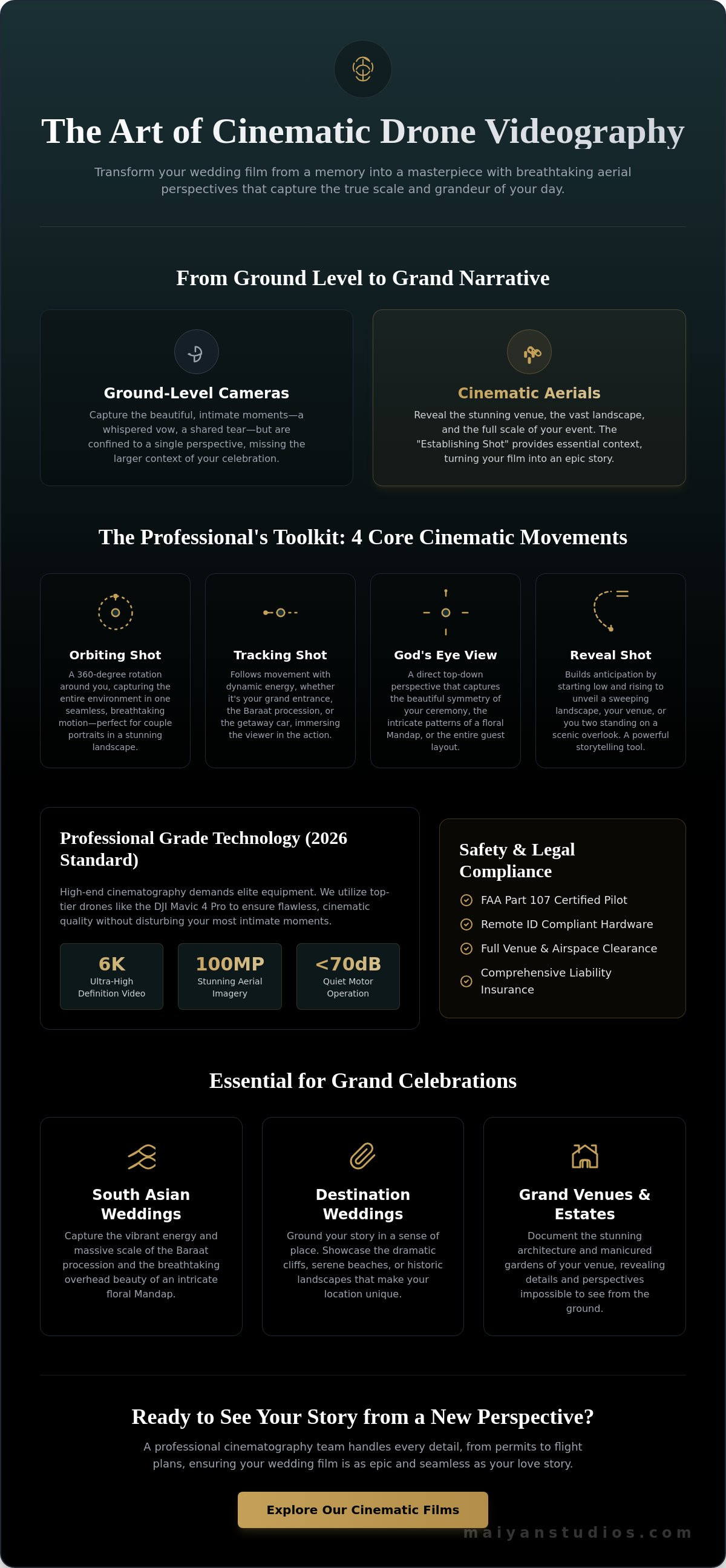
Professional drone wedding videography is the art of using an Unmanned Aerial Vehicle (UAV) to capture cinematic, high-definition footage that ground-based cameras simply cannot reach. It's far more than just a camera in the sky; it's a narrative tool that provides context, scale, and grandeur. In 2026, the gap between hobbyist drones and professional cinematography has widened significantly. High-end equipment like the DJI Mavic 4 Pro now delivers 6K video and 100MP imagery, allowing for crisp, noise-free shots even in the soft light of a sunset ceremony. These modern drones also feature significantly quieter motors, ensuring your vows remain the focus while the camera captures the scene from above.
The "Establishing Shot" serves a vital psychological purpose in your wedding film. It tells the viewer exactly where the story takes place, grounding the emotional moments in a physical reality. For luxury weddings, where the venue is often a character in itself, this aerial perspective is essential. It moves the film from a simple recording of events to a professional production that rivals the silver screen. By investing in high-quality drone wedding videography, you ensure the architecture of your venue and the landscape of your destination are documented with the same care as your guest list.
The Aesthetic Value of Aerial Perspectives
Aerial shots provide a sense of place that is particularly powerful for destination weddings. Whether it's a cliffside in Amalfi or a historic estate in the English countryside, a drone captures the environment that defines your day. For grand celebrations, especially South Asian weddings with hundreds of guests, ground-level cameras can feel claustrophobic. A drone reveals the true scale of the crowd and the intricate details of a Mandap or outdoor floral installation. It also allows for a cinematic reveal shot, slowly rising over a treeline to find the couple, building anticipation in a way that feels intentional and grand.
Drone vs. Ground-Level Cameras: A Comparison
While drones provide the big picture, they aren't a replacement for traditional wedding cinematography. Instead, they act as a vital complement. Ground-level cameras capture the intimate tears, the whispered "I do," and the texture of the lace on a gown. Drones add the unique parallax effect, where foreground objects move faster than the background, creating a deep sense of three-dimensional space. A balanced narrative uses both. You need the close-up of a ring exchange, but you also need the wide aerial of the entire wedding party walking through a manicured garden. This combination ensures your film feels comprehensive and visually diverse.
Cinematic Techniques: How Professionals Use Drones for Storytelling
Hobbyist drone work often looks like a series of static snapshots from the sky. In contrast, professional drone wedding videography relies on fluid, complex movements that guide the viewer's eye through the narrative of your day. These techniques distinguish a high-end production from a simple aerial photo. Professionals use specific flight patterns to create emotional weight and visual interest that ground cameras cannot replicate. When these shots are woven into your final film, they provide a sense of momentum and grandeur that defines the luxury aesthetic.
Orbiting shots are a staple of cinematic storytelling. By keeping the camera locked on the couple while the drone circles in a perfect 360-degree arc, the pilot captures the entire environment in one continuous motion. Tracking shots add a different energy, allowing the camera to follow the getaway car or the couple’s grand entrance into a reception. This creates a dynamic perspective that feels immersive. For artistic symmetry, "God’s Eye" views look straight down at the ceremony site or the mandap, highlighting the geometric beauty of your decor. Finally, the "Reveal" shot starts low at ground level and rises quickly to unveil a sweeping landscape, a technique often used to transition between chapters of the wedding day.
Safety and legality underpin every cinematic choice. A professional cinematography team ensures all flights comply with FAA Part 107 regulations, which is the baseline for legal commercial operation. This expertise allows you to focus on your celebration while the team manages the technical and regulatory details behind the scenes. If you want to see how these techniques look in practice, exploring our options for luxury wedding cinematography can help you visualize the impact of aerial storytelling.
The Importance of Gimbal Stabilization and Resolution
Shaky footage is the fastest way to break the cinematic spell. Professional drones in 2026, such as the DJI Mavic 4 Pro, utilize advanced three-axis gimbals to keep the 6K image perfectly level, even in moderate winds. High frame rates are equally important. By filming at 60 or 120 frames per second, videographers can slow the footage down in post-production, creating dreamy, ethereal aerials. This technical precision ensures the drone footage matches the color profile and quality of the ground-level cinema cameras for a seamless viewing experience.
Lighting and Timing: The Golden Hour Aerials
Timing is everything in aerial cinematography. The "Golden Hour," the period just before sunset, provides the soft, directional light that makes drone footage look truly magical. During this time, shadows are long and textures are emphasized, which is ideal for capturing the sprawling grounds of a luxury venue. Professionals also manage lens flare and exposure levels carefully to prevent blown-out skies. With modern sensors, even night-time drone work is possible, allowing for stunning captures of fireworks or illuminated outdoor receptions without losing detail in the darkness.
Capturing the Scale of South Asian Wedding Rituals
South Asian weddings are defined by vibrant energy and massive scale. For these celebrations, drone wedding videography isn't just an add-on; it's a necessity to capture the sheer volume of the festivities. The Baraat is a moving feast of music and dance. A ground camera captures the groom's expression, but only a drone shows hundreds of relatives dancing in a synchronized wave toward the venue doors. This perspective emphasizes the community and joy that ground-level shots can't fully encompass. Similarly, the intricate floral architecture of outdoor Mandaps is best appreciated from a "God's Eye" perspective. This angle reveals the geometric precision of the decor against the backdrop of a luxury estate or beach.
During Sangeet nights, the scale of the dance performances often requires a wide field of view. An aerial camera tracks the movement across the stage while highlighting the complex lighting designs that ground crews might miss. When the festivities conclude with the Vidai, the drone provides a poignant perspective. Following the couple's car as it drives away from the venue offers a cinematic sense of finality. This perspective emphasizes the transition from the grand celebration to the beginning of their private journey together. It's a visual metaphor that adds emotional depth to the final wedding film.
Managing the Complexity of Multi-Day Events
South Asian weddings often span three or more days, which requires rigorous logistical planning. A professional cinematography team manages a rotation of batteries and charging stations to ensure coverage for every ritual, from the Mehndi to the Reception. Coordinating with other vendors is also vital. In crowded spaces with horses, cars, and hundreds of guests, the pilot must maintain a clear flight path that doesn't interfere with the flow of the ceremony. This level of planning ensures that the high-energy moments are captured without any technical interruptions.
Respecting the Ritual: Noise and Distraction Management
While the visuals are important, the sanctity of the ritual comes first. Noise management is a top priority for experienced pilots. They often stay grounded during quiet prayers or use long-focal length lenses to capture the scene from a distance. This follows common drone wedding photography tips regarding being a silent observer. Communicating with the Pandit or Priest beforehand ensures the drone's presence is expected and respected. This professional approach prevents the technology from becoming a distraction during sacred moments, allowing the couple to stay present in their ceremony.
Logistics, Safety, and Legal Requirements for 2026
Operating a drone for commercial purposes involves much more than just pushing a joystick. Legal compliance is the foundation of professional drone wedding videography. In the United States, the Federal Aviation Administration (FAA) requires all commercial pilots to hold a Part 107 remote pilot certificate. This isn't a suggestion; the FAA actively monitors compliance and can issue fines starting at $1,100 per violation. By 2026, the regulatory landscape has become even more sophisticated with the full implementation of Remote ID. Since March 16, 2024, it's been mandatory for drones to broadcast their location and identification. Flying without this can result in fines as high as $27,500. New regulations expected in mid-2026 under Part 108 may expand these capabilities even further, potentially allowing for more advanced flight paths without individual waivers.
Beyond federal laws, luxury venues and private estates have their own sets of rules. Many high-end properties are designated as "No-Fly Zones" or require specific written permission from the estate manager. Professional teams carry at least $1 million in liability insurance, which is a standard requirement for most luxury venues. This insurance protects the property and the guests, providing peace of mind that hobbyist pilots simply can't offer. Weather also plays a critical role. While modern drones are resilient, they have strict operational limits. Pilots generally ground their craft if sustained winds exceed 20 to 25 mph or if there's any active precipitation, as rain can damage sensitive internal electronics and ruin the lens clarity.
Navigating Destination Wedding Permits
If you're planning a celebration in a global hotspot like Lake Como, Bali, or the Greek Isles, the legal complexity increases. Each country has its own aviation authority and permit timeline. Some regions require applications to be submitted at least 30 to 60 days in advance. We handle the intricate global logistics for our destination wedding coverage, ensuring that all international flight permits are secured long before the first guest arrives. This proactive approach prevents last-minute disappointments or legal issues at the border, allowing the focus to remain on the celebration.
Safety Protocols on the Wedding Day
Safety is never left to chance. A professional team conducts a pre-flight site survey to identify obstacles like power lines, trees, or high-interference areas. We follow a strict "Do Not Fly Over People" rule to ensure guest safety, instead using angles that create the illusion of being over the crowd while maintaining a safe lateral distance. We also carry backup equipment for every shoot. If a technical glitch occurs with the primary craft, a secondary drone is ready to launch. This redundancy ensures that the most critical moments of your day are captured regardless of equipment performance.
How to Choose the Right Drone Videographer for Your Wedding
Choosing a provider for drone wedding videography requires looking past the novelty of a bird's eye view. Height is easy. Storytelling is hard. When you review a portfolio, pay close attention to the fluidity of the camera movements. Amateur pilots often produce "jerky" footage where the camera tilts or pans abruptly; a true professional delivers smooth, gimbal-stabilized transitions that feel like a high-budget film. You should also ask about the specific equipment they use. While consumer-grade drones are common, luxury cinematography requires professional-grade cinema drones with large sensors to ensure the aerial footage matches the depth and color of the ground cameras.
There's a distinct advantage to hiring a unified team for your wedding photography and cinematography. When your drone pilot and ground crew belong to the same studio, they operate with a synchronized flight plan. They know exactly where the other is standing. This prevents the drone from accidentally appearing in the background of your most important photos. This coordination is particularly vital during grand entrances or outdoor ceremonies where space is limited. A single, cohesive team ensures that every angle is covered without the vendors competing for the best spot. It also guarantees that the final edit will have a consistent visual style from start to finish.
Essential Questions to Ask Your Pilot
Before signing a contract, you need to ensure your pilot is prepared for the specific logistical challenges of your venue. Start with these three critical questions:
Are you licensed and insured for this specific location? While we discussed FAA Part 107 earlier, international destinations often require local certifications that must be verified in advance.
How do you handle privacy and noise during the ceremony? A professional should have a plan for using zoom lenses or maintaining a specific altitude to ensure the drone remains a silent observer.
What is your backup plan if weather prevents flying? Since drones cannot fly in heavy rain or high winds, ask how they will compensate for those missing shots using ground-level creative techniques.
The Maiyan Studios Signature: Seamless Aerial Integration
Our philosophy is that technology should enhance your story, not distract from it. We specialize in luxury and South Asian weddings, where the scale of the event demands a sophisticated aerial perspective. We don't just "fly a drone" during your celebration. We plan specific flight paths that complement the energy of the Baraat and the intricate beauty of the Mandap. By integrating these shots thoughtfully into the final edit, we create a narrative that feels both intimate and grand. Contact us to discuss your luxury wedding cinematography and learn how we can bring an epic, cinematic scale to your wedding film.
Elevate Your Love Story Beyond the Horizon
Integrating drone wedding videography into your celebration is about more than just a camera in the sky. It's about grounding your luxury film in its unique environment and capturing the true scale of your most cherished rituals. From the high-energy movement of a Baraat to the quiet elegance of a coastal ceremony, aerial storytelling provides a cinematic perspective that ground cameras simply can't achieve. You now understand the importance of choosing a team that balances artistic vision with strict adherence to 2026 FAA safety and Remote ID regulations.
A professional approach ensures your film is both breathtaking and legally compliant, especially for complex multi-day events. As specialists in luxury South Asian celebrations and global destination wedding coverage, we bring the expertise needed to navigate international permits and venue restrictions. Our FAA licensed and insured pilots focus on creating a visual masterpiece that reflects the grandeur of your day without ever becoming a distraction. Elevate your story with Maiyan Studios cinematography. Your wedding is a once-in-a-lifetime event; make sure its story is told from every magnificent angle.
Frequently Asked Questions
Do I need a separate drone pilot for my wedding?
A dedicated drone pilot is highly recommended for luxury events. While some lead videographers are licensed to fly, having a separate pilot allows your main cinematography team to focus entirely on the intimate moments on the ground. This division of labor ensures that a crucial vow or a tearful glance isn't missed while the aerial camera is capturing the venue's scale from above.
Are drones loud enough to ruin my wedding ceremony?
Modern drones used in drone wedding videography are significantly quieter than older models. Professional pilots use long-focal length lenses to capture ceremony shots from a distance, making the craft virtually inaudible to your guests. We also coordinate with your officiant to ensure the drone only flies during transitions or music-heavy segments to maintain the sanctity of your vows.
What happens if it rains on my wedding day? Can the drone still fly?
Drones cannot fly in active rain or heavy mist. Moisture can damage the internal flight controllers and blur the camera lens, making the footage unusable. If weather prevents flying, professional teams rely on ground-based creative techniques to capture the venue's grandeur. We always monitor live weather radar to find clear windows for short flights between passing showers.
Is drone footage included in standard luxury wedding packages?
Drone coverage is often a standard feature in high-end luxury wedding cinematography packages. However, it can also be offered as a specific add-on depending on the venue's location and legal restrictions. It's best to check your specific package details to see if aerial storytelling is included or if it requires a separate booking for a licensed and insured pilot.
Can a drone fly indoors for my reception or ballroom entrance?
Indoor flights are possible with specialized equipment. Small "cinewhoop" or FPV drones with protected propellers allow for safe flythroughs of grand ballrooms or dramatic reception entrances. These require a high level of pilot skill and a pre-flight site survey to ensure there is enough clearance from chandeliers, floral decor, and your guests.
How long does a drone typically fly during a wedding day?
A drone doesn't fly continuously throughout the day. Instead, it captures key moments like the guest arrival, the ceremony exit, and sunset portraits. Most professional setups involve 15 to 20-minute flight intervals. Over a full wedding day, a pilot might accumulate 60 to 90 minutes of total aerial footage, focusing strictly on high-impact cinematic shots that advance the story.
Do I need to get permission from my venue for drone videography?
You must always obtain permission from your venue before flying. Many luxury estates and historic properties have specific rules regarding takeoff and landing zones. We coordinate directly with venue managers to provide our FAA Part 107 certification and proof of liability insurance, which are typically required for approval. This proactive step prevents any logistical delays on your wedding day.
Is drone videography safe for my guests?
Safety is the top priority for professional drone wedding videography. We follow strict FAA guidelines that prohibit flying directly over unprotected people. By using lateral angles and high-zoom lenses, we create the appearance of being close to the crowd while maintaining a safe physical distance. Our pilots also use emergency return-to-home protocols and pre-planned flight paths to ensure a secure environment for everyone.


Comments