
Emotional Vidai Ceremony Photography: Capturing the Heart of the Farewell
The car door stands open, the rice is thrown, and a final, tearful embrace marks the end of one chapter and the beginning of another. For many families, the fear that a photographer might disrupt this sacred, private goodbye is just as stressful as the departure itself. You want to remember the raw honesty of the moment, yet you worry that the chaos of the crowd or the harsh outdoor lighting will result in photos that feel staged or cluttered. Professional emotional Vidai ceremony photography isn't about directing the action; it's about the art of the "invisible presence" where empathy matters as much as the lens.
We understand that you want a gallery that feels like a cinematic film, capturing the heart of the farewell without making you feel like you're on a movie set. This guide explains how luxury photography preserves these fleeting emotions with grace and technical precision. We'll walk through the techniques used to stay unobtrusive, how to handle difficult lighting during a departure, and how to ensure your photos make you feel every bit of that day's love for decades to come.
Key Takeaways
Understand why the Vidai is the emotional peak of the South Asian wedding and how to document this ritualistic departure with cinematic depth.
Learn how to capture the specific symbolism of the Rice Toss and the intimate family dynamics during final hugs without interrupting the moment.
Discover why a "fly on the wall" approach to emotional Vidai ceremony photography is essential for preserving raw, unscripted tears over staged poses.
Get practical tips on coordinating with your planner to ensure the departure path is clear of clutter and perfectly lit for high-end visual storytelling.
Explore how blending fine art editorial techniques with documentary photojournalism creates a timeless gallery that feels like a film.
Table of Contents
What is Emotional Vidai Ceremony Photography?
Emotional Vidai ceremony photography is the specialized art of documenting a bride’s ritualistic departure from her parental home. While the rest of the wedding day often feels like a whirlwind of celebration, the Vidai represents the soulful silence at the end of the journey. It's the moment where the gravity of the transition truly sinks in for the couple and their families. This style of photography focuses on the raw, unscripted human connections that surface when tradition meets personal loss and new beginnings.
The energy shifts dramatically during this phase of the event. You move from the joyful chaos of the Baraat and the structured beauty of the Mandap to a space filled with heavy, heartfelt goodbyes. Professional photography bridges the gap between these ancient rituals and the genuine tears shared between a family. It captures the fleeting glances that words cannot describe, ensuring that the depth of the farewell is preserved with cinematic clarity. By focusing on the heart of the exit, photographers create a narrative that feels both grand and deeply personal.
The Cultural Weight of the Farewell
The Vidai is far more than just an exit; it symbolizes the profound transition from daughter to wife. In many traditions, the Vidai ceremony rituals involve specific acts of gratitude and blessing, such as the bride throwing rice over her head to wish her parents prosperity. These are the final moments spent in the home where she grew up, and the weight of that history is palpable. Capturing these scenes with sensitivity ensures they become the most moving chapters in a luxury wedding album, serving as a permanent record of a family's legacy and love.
Why "Emotional" Photography Differs from Standard Coverage
Standard event coverage often focuses on the "what" of the ceremony, but emotional Vidai ceremony photography focuses on the "how." It prioritizes micro-expressions over wide-angle group shots. A photographer trained in this style looks for the quivering lip, the white-knuckled grip of a final hug, or a mother’s silent gaze from the doorway. It requires a high degree of cultural empathy to know where to stand and when to pull back. In these moments, the creative team acts as a silent witness rather than a director. There is no posing allowed here. The goal is to remain invisible while documenting the truth of the farewell, allowing the family to remain fully present in their private moment without feeling watched.
The Anatomy of a Vidai: Rituals That Spark Emotion
The Vidai is composed of several micro-rituals, each acting as a catalyst for deep expression. These moments aren't just for show; they carry the weight of the psychological impact of family rituals, helping participants process the life-altering change of a wedding. For a photographer, understanding the choreography of these events is vital for successful emotional Vidai ceremony photography. It's about being in the right place before the emotion even breaks.
While every family is different, certain milestones within the ceremony consistently spark the most poignant images. The threshold of the home serves as a physical and symbolic boundary. As the bride crosses this line, the reality of her new life begins. Photographers must also watch the dynamics during the final hugs. The way a father holds his daughter or the way siblings cling to one another tells a story of a household's specific bond. Even the choice of the departure vehicle, ranging from traditional palkis to modern luxury supercars, adds a unique visual layer to the story of the exit.
Capturing the Rice Toss (Khoi) with Precision
The Khoi ritual is the moment where gratitude and grief coexist in a single gesture. Technically, this is one of the hardest shots to nail. To freeze the motion of the rice while keeping the bride’s face in sharp focus requires fast shutter speeds and expert timing. We often use a wide-angle lens for this shot. This allows us to document the bride's action in the foreground while simultaneously capturing the tearful reactions of the family members standing behind her. It creates a layered, three-dimensional story that feels alive.
The Car Departure: The Final Goodbye
The final moments inside the car often provide the most cinematic opportunities. Shooting through glass presents challenges with reflections and low light, especially during evening departures, but these technical hurdles often enhance the moody, film-like aesthetic. The "Hand on the Window" shot is a classic for a reason. It captures the final physical connection between the bride and her family as the vehicle begins to move. During this transition, we also focus on the groom’s supportive presence. Seeing him offer a steadying hand or a quiet word of comfort adds a necessary layer of hope to the farewell. If you're looking for a team that prioritizes these delicate details, our wedding photography services focus on capturing the soul of the event.
Candid vs. Cinematic Storytelling: Which Style Wins?
The debate between candid and cinematic styles often misses a crucial point: the best emotional Vidai ceremony photography requires both. During this sensitive ritual, traditional posing is strictly forbidden. You don't want a photographer asking you to "look sad" or "re-hug" your father for a better angle. Instead, we adopt a "fly on the wall" approach. By using long lenses, like the 70-200mm f/2.8, we give your family the physical space to grieve and embrace without feeling a camera is inches from their faces. This distance allows for genuine interaction. It's the difference between a staged shot and a real memory.
This hybrid method uses sophisticated editorial lighting techniques to ensure the scene looks beautiful, even in dark driveways or chaotic crowds, but it maintains a documentary-style mindset. We aren't there to change the scene; we're there to witness it. While photography captures the frozen instant, wedding cinematography adds a layer of sound and motion that stills simply cannot reach. Combining these two approaches ensures that every subtle detail is preserved.
The Power of Photojournalism in the Vidai
Unscripted moments carry far more weight than anything planned. True photojournalism in a Vidai focuses on more than just the bride's face. It documents the reactions of the "forgotten" family members, such as the quiet tears of a grandfather or the confused sadness of a younger sibling standing on the periphery. We aim to tell the story in five distinct frames: the nervous anticipation before the exit, the ritualistic rice toss, the peak of the emotional embrace, the physical departure in the vehicle, and the quiet aftermath on the doorstep. This narrative structure ensures your final gallery feels complete and authentic.
Integrating Film for a Multi-Sensory Experience
A photograph can capture a tear, but it can't capture the sound of a final whispered prayer or the heavy sob of a mother. This is why luxury wedding photo and video teams are so effective for South Asian weddings. Film provides a multi-sensory experience that photography alone might miss. We use slow-motion techniques to emphasize the weight of the bride's departure, making every second feel as significant as it truly is. Having a single team handle both ensures a cohesive emotional narrative. The colors, the lighting, and the storytelling style remain consistent across both mediums, creating a unified legacy of your farewell.
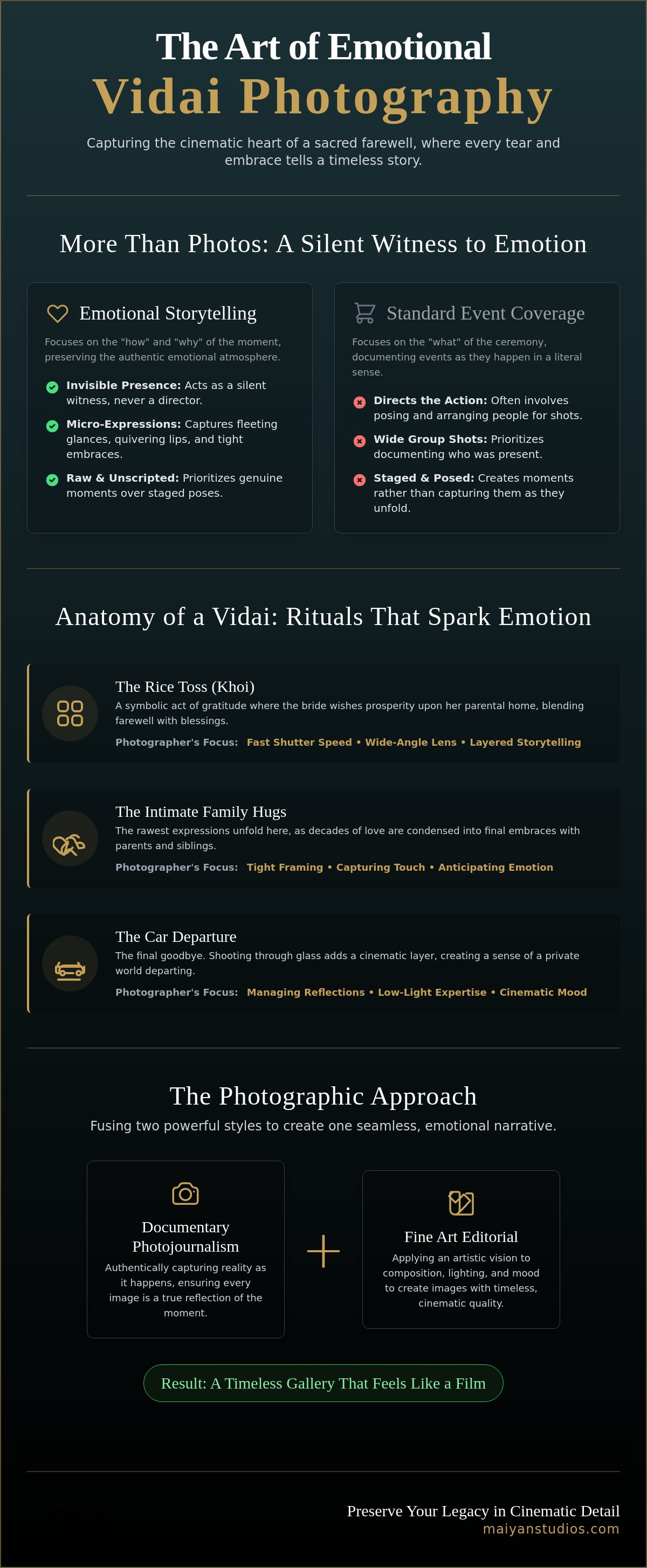
Planning for the Unplannable: Tips for a Flawless Vidai
While the Vidai is an inherently spontaneous event, the environment surrounding it shouldn't be left to chance. To achieve truly impactful emotional Vidai ceremony photography, a balance between raw emotion and logistical preparation is required. The goal is to create a "protected space" where the family can express themselves without the distraction of clutter or technical failures. This starts with a detailed conversation with your wedding planner to ensure the departure path is clear of "photobombers" and unsightly objects like luggage or discarded programs.
Managing the crowd is equally important. We recommend establishing a "buffer zone" of a few feet around the bride and her immediate family. This prevents the couple from being swallowed by a sea of guests, allowing the photography team to capture clean, unobstructed shots of the final embraces. Encouraging a "no-phone zone" for this specific ritual is also a game-changer. When guests put their devices away, the professional team can capture clear faces and genuine eye contact rather than a wall of glowing screens and extended arms.
The Logistics of a Luxury Departure
Luxury departures often involve high-end vehicles and complex venue exits that require foresight. Positioning the car is critical. It needs to be angled to catch the best available light while providing enough room for the camera team to move. Transitioning from a brightly lit ballroom to a dark outdoor setting is a major technical hurdle. We use discreet off-camera flash units to mimic ambient street lighting, maintaining a cinematic look without the harshness of a direct camera flash. If your exit involves restricted areas, ensure your luxury 3-day wedding photography team has the necessary credentials or permits well in advance to avoid any last-minute disruptions.
Advice for the Couple: Being Present
The best thing you can do for your photos is to forget the cameras exist. Trust your team completely so you can focus entirely on your parents and siblings. The Vidai often feels rushed because of the day's schedule, but the most powerful images come from slow, intentional movements. Take your time with every hug and every prayer. It's also helpful to communicate any sensitive family dynamics to your photographer beforehand. Knowing who the key figures are and which relationships are most significant allows the team to prioritize the right moments. If you want a team that respects your privacy while documenting your legacy, contact Maiyan Studios to discuss your wedding coverage.
Why Maiyan Studios is the Authority on Emotional Storytelling
Maiyan Studios treats the Vidai as the emotional heartbeat of the entire wedding journey. It isn't just another item on a checklist. It's a sacred transition that requires a specific level of artistic maturity to document correctly. Our approach to emotional Vidai ceremony photography is rooted in a deep respect for the sanctity of the ritual. We don't just take pictures; we capture cinematic beauty while remaining entirely unobtrusive. Our signature style is a unique blend of fine art editorial—the kind of images that look like they belong in a high-fashion magazine—and raw photojournalism that documents the unvarnished truth of the day.
Our experience with high-profile South Asian weddings worldwide has taught us that every family has a different rhythm. We've documented these ceremonies in various cultural contexts, from grand city ballrooms to intimate family courtyards. This global perspective allows us to anticipate the "Vidai arc" before it even happens. Our dedicated cinematography team works in perfect synchronization with our photographers. They understand the cadence of the farewell—the quiet prayers, the sudden bursts of emotion, and the finality of the car's departure. This synergy ensures that no moment is missed. Your visual narrative remains cohesive across both mediums, providing a seamless transition between the frozen moments of photography and the moving story of film.
A Legacy of Empathy
Our lead creatives don't just show up with high-end equipment. They prepare for the emotional weight of each wedding by learning about your family dynamics and specific traditions. We see ourselves as guardians of your heritage. We're documenting these traditions for your future children and grandchildren to experience years from now. It's a responsibility we take seriously. You can view our portfolio of luxury South Asian wedding films to see how we translate these raw feelings into cinematic legacies. Every frame is a testament to our commitment to empathy and artistic excellence.
Book Your 2026 Celebration
If you're planning a 2026 destination or luxury wedding, now is the time to secure your dates. We maintain limited availability each year to ensure every couple receives our full creative focus and personalized service. We offer customized packages for multi-day South Asian celebrations that can include:
Full-day wedding photography and cinematography coverage.
Engagement sessions and pre-wedding shoots.
Luxury destination wedding coverage worldwide.
Editorial-style post-production and fine art albums.
Our team is ready to travel wherever your love story takes you. Contact us today to discuss how we can preserve your wedding story with the grace and cinematic depth it deserves.
Preserving the Soul of Your Farewell
The Vidai is much more than a departure. It's the moment your family's history and your future path intersect in a single, powerful farewell. We've explored how the right technical approach, from using long lenses to mastering low-light exits, allows your photographer to remain a silent witness to these sacred rituals. By prioritizing candid storytelling over staged poses, you ensure that the tears, the laughter, and the final hugs remain entirely authentic.
Investing in professional emotional Vidai ceremony photography means choosing a team that understands the cultural weight of every gesture. As a studio featured in Maharani Weddings with specialized expertise in luxury Sikh, Hindu, and Muslim rituals, we bring our global destination wedding experience to your celebration. We're committed to capturing the raw beauty of your transition with the cinematic depth it deserves.
Preserve your family’s most emotional moments with Maiyan Studios. Your wedding day is a once-in-a-lifetime event, and you deserve a gallery that allows you to feel the warmth of that final embrace for a lifetime.
Frequently Asked Questions
What is the best time of day for Vidai photography?
The best time for Vidai photography is during the soft, natural light of the early morning or late afternoon, often referred to as the golden hour. However, because the Vidai is a live event, it often occurs late at night or during the mid-day sun. Professional teams adapt by using high-quality lenses and external lighting to ensure the images remain cinematic regardless of the sun's position.
How do photographers handle low light during an evening Vidai?
Photographers handle low light by utilizing fast prime lenses with wide apertures and discreet off-camera flash setups. Instead of a harsh, direct flash that ruins the mood, we bounce light off nearby surfaces or use softboxes to mimic ambient street lamps. This technique preserves the intimate atmosphere of emotional Vidai ceremony photography while ensuring every tear and expression is crisp and visible.
Should we have a second photographer specifically for the Vidai?
Having a second photographer is highly recommended for the Vidai to capture multiple perspectives simultaneously. While one photographer focuses on the bride's expressions, the second can document the emotional reactions of parents, siblings, and the groom. This dual coverage ensures a more complete story, as these fleeting moments happen too quickly for a single person to capture from every angle.
Can the Vidai be filmed if it is very private?
Yes, the Vidai can and should be filmed even if it's a private family moment. Professional cinematography teams use long telephoto lenses to maintain a respectful distance, ensuring they don't intrude on the family's space. High-fidelity microphones can be placed discreetly to capture whispered blessings and prayers, allowing you to relive the sounds of the farewell without feeling like you were being watched.
What are the most important shots to include in a Vidai shot list?
The most critical shots include the Khoi rice toss over the shoulder, the bride crossing the home's threshold, and the final hugs with elders. You should also prioritize the hand on the car window shot and the father's reaction as the vehicle pulls away. These specific milestones serve as the emotional anchors of your wedding gallery, representing the physical and symbolic transition of the day.
How do we prevent guests with phones from ruining the Vidai photos?
Preventing guests from using phones is best handled through a polite announcement by the officiant or MC before the departure begins. You can also place unplugged ceremony signage near the exit. When guests put their devices away, it allows the professional emotional Vidai ceremony photography team to capture unobstructed views of your family's faces instead of a sea of smartphones and raised arms.
Is it okay to cry during the Vidai photos?
It's absolutely okay, and even expected, to cry during the Vidai. These photos are meant to document the authentic heart of your farewell, not a polished performance. Raw, honest emotion is what gives these images their power and longevity. Don't worry about your makeup or how you look; the most beautiful photos are always the ones where the love and connection are real.
How long does a typical Vidai ceremony take to photograph?
A typical Vidai ceremony takes between 15 and 45 minutes to photograph, depending on the number of family members involved in the farewells. While the rituals themselves are relatively quick, the individual goodbyes with parents, siblings, and extended family can extend the timeframe. We recommend building a small buffer into your schedule so you don't feel rushed during these final, precious moments at home.
Comments