
25+ Creative Baraat Entrance Photos: A 2026 Guide to Luxury Visual Storytelling
- Maiyan Studios
- Jun 23
- 11 min read
What if your Baraat entrance wasn't just a loud procession, but a carefully choreographed cinematic sequence that looks as good in a luxury magazine as it does in your memory? Most grooms worry that their grand entry will end up looking like a cluttered, chaotic blur of faces rather than the high-end spectacle they planned. It's a common fear that the "typical" horse or vintage car entry feels a bit dated in a world of drone light shows and AI-enhanced wedding films.
We're here to show you how to capture creative Baraat entrance photos that masterfully blend grand scale with intimate, emotional storytelling. You'll discover how to transform your arrival into a masterpiece using technical photography tips, luxury styling, and the latest 2026 trends. This guide explores over 25 innovative concepts, from synchronized drone displays to golden hour timing, ensuring your photo and video team captures every high-energy moment with precision.
Table of Contents
Mastering the Energy: Why Creative Baraat Entrance Photos Matter
The Baraat is the high-octane prologue to your wedding ceremony. It's the moment when the groom's energy meets the anticipation of the bride's family. Capturing this requires more than just pointing a camera at a crowd. Standard photography often fails here because it gets swallowed by the chaos. Without a strategic plan, you end up with photos of the back of people's heads or a cluttered mess that hides the groom's excitement. This is why creative Baraat entrance photos are essential; they provide a structured narrative for the most boisterous part of the day.
Luxury visual storytelling isn't about snapping every dance move. It's about curation. By leveraging specific South Asian wedding photography styles, you can set a mood that feels both grand and intimate. Whether it's the regal stillness of a groom on a vintage car or the explosion of color from smoke bombs, the goal is to define the event’s tone before the first ritual even begins. It's about creating a visual bridge between the morning preparations and the sacred ceremony ahead.
The Cultural Significance of the Groom’s Arrival
The Baraat wedding procession marks a profound transition. It represents the groom leaving his family home to join the bride’s side. We focus on the emotional weight of this journey, particularly during the Milni, where the two families officially meet. It's a high-stakes moment for photography. The "first look" from the bride’s family is a key shot that captures the merging of two lineages. These photos aren't just about the party; they're about the union of two communities.
Defining the 2026 Luxury Aesthetic
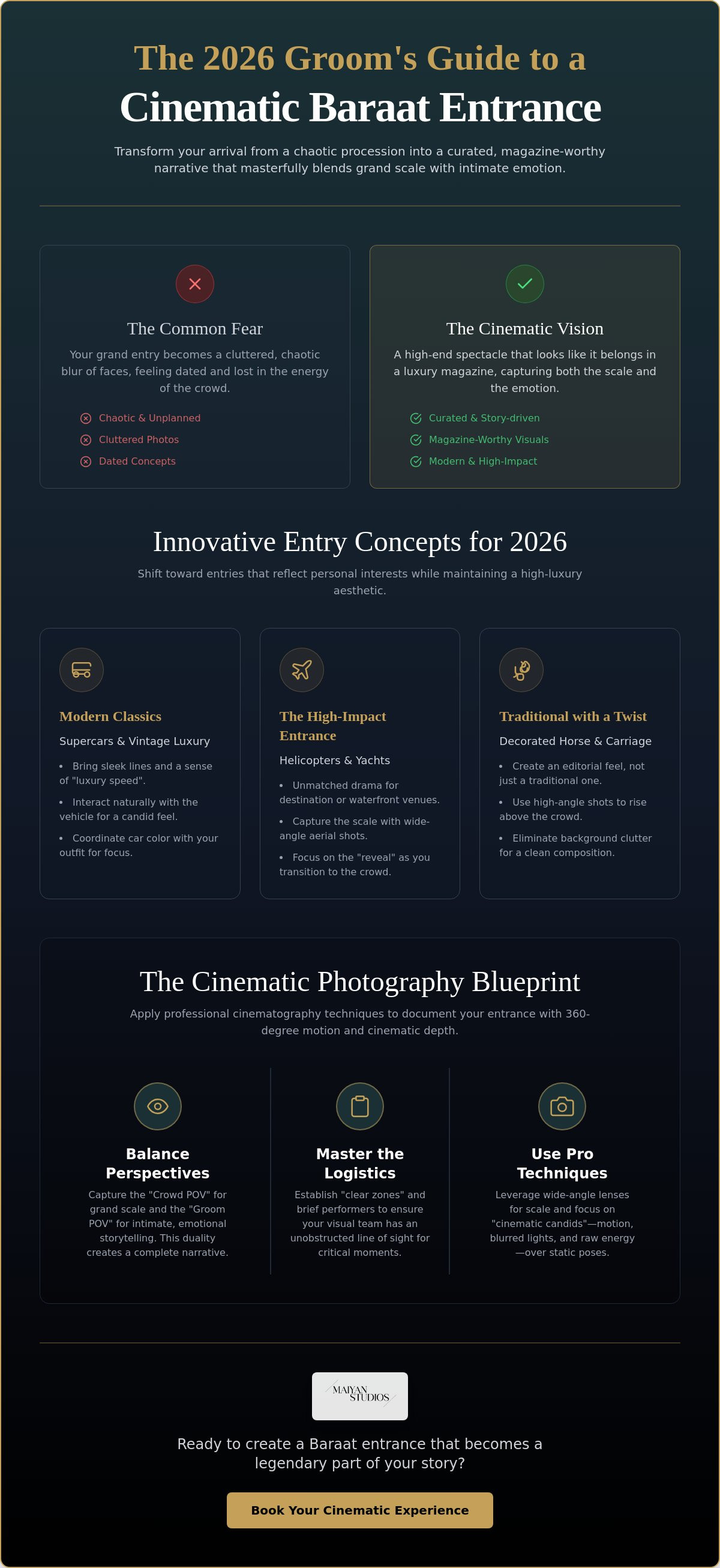
For 2026, the trend has shifted away from "busy" shots. We're seeing a move toward editorial, clean compositions that look like they belong in a high-fashion magazine. To achieve this, we use wide-angle lenses to capture the sheer volume of the crowd while keeping the groom as the focal point. We also prioritize "cinematic candids" during the dance-off. Instead of frozen, awkward poses, these shots emphasize motion, blurred lights, and raw energy. This approach ensures your creative Baraat entrance photos feel modern, sophisticated, and entirely alive.
Innovative Baraat Entry Concepts for the 2026 Groom
Choosing your arrival method is a defining moment for your wedding day narrative. In 2026, we're seeing a shift toward entries that reflect the groom's personal interests while maintaining a high-luxury aesthetic. Whether you're gliding in on a yacht or revving the engine of a supercar, these choices provide the foundation for creative Baraat entrance photos that stand out from the crowd. These entries aren't just for show; they're a modern interpretation of a deeply rooted tradition, as explored in this Cross-Cultural Study of Weddings, which highlights how rituals adapt to contemporary identities.
Modern Classics: Supercars and Vintage Luxury
Exotic cars bring sleek lines and a sense of "luxury speed" to your photos. To avoid looking staged, interact with the vehicle naturally. Lean against the hood or check your cufflink as the door opens; these small actions create a candid feel. We often capture the "motion blur" of a slow-rolling car to emphasize the energy of the procession. A professional tip is to coordinate the car’s color with your Sherwani. A matte black Lamborghini creates a stunning contrast against a gold or ivory outfit, ensuring you remain the focal point of every shot.
The High-Impact Entrance: Helicopters and Yachts
For destination weddings or waterfront venues, air and water arrivals are unmatched for drama. Capturing a helicopter landing requires precise coordination between the pilot and the photo team. We prioritize wide-angle aerial shots to show the scale of the landing zone. If you're arriving by yacht, the "reveal" is the most critical moment. As you step onto the dock, we focus on the transition from the serene water to the high-energy crowd. Safety is paramount here; keeping a designated clear zone doesn't just protect guests, it also ensures your creative Baraat entrance photos aren't obstructed by safety personnel.
Traditional with a Twist: The Decorated Horse and Carriage
The traditional horse remains a favorite, but the 2026 approach is more editorial. We use high-angle shots to capture the groom from above the crowd, which highlights the intricate "Ghari" and floral decorations on the horse. This perspective also helps eliminate background clutter from the dancing guests. Working with animals can be unpredictable, so we focus on capturing the groom’s calm composure amidst the excitement. If you want to blend heritage with modern flair, consider a decorated Tuk-tuk or Rickshaw. These fusion entries offer a playful touch that looks incredible in a luxury wedding album. If you're planning a unique arrival, Maiyan Studios can help you map out the perfect angles to capture every second of the spectacle.
The Technical Art of Cinematic Baraat Photography
Capturing the high-energy spirit of the Baraat requires more than just a fast shutter speed. It involves applying advanced wedding cinematography techniques to static images, creating a sense of 360-degree motion even in a single frame. The technical execution of creative Baraat entrance photos relies on managing the environment's unpredictability while maintaining a high-end, editorial look. This isn't just about documenting an arrival; it's about using the camera to translate the thumping drums and cheering crowds into a visual experience that feels just as loud years later.
To achieve this, we focus on The Art of Visual Storytelling by balancing two distinct perspectives: the "Crowd POV" and the "Groom POV." You need the wide, sweeping shots of the hundred-person dance floor to show scale, but you also need tight, intimate close-ups of the groom's expression as he's greeted by his future in-laws. This dual-layered approach ensures the narrative is complete. Because these moments happen simultaneously, luxury South Asian weddings typically require multiple shooters to cover every angle without missing a beat.
Advanced Drone Coordination for Scale
Drones have changed the way we view the Baraat. We don't just fly them for height; we use them to capture the "Grand Reveal" from 100 feet up as the groom first appears. From this vantage point, the geometry of the dancing crowd creates stunning patterns that are invisible from the ground. The orbital drone shot is a must-have for capturing the dynamic energy of a Baraat. It provides a sense of scale that ground-based cameras simply can't replicate, turning a crowded street into a structured masterpiece of motion.
Lighting the Chaos: Flash vs. Natural Light
Lighting is the biggest challenge during a Baraat. Whether you're dealing with the harsh midday sun or a low-light evening entrance, the strategy must be precise. We often use off-camera flash to "freeze" the dancers in mid-air, ensuring every bead of sweat and flying petal is sharp. If your entrance coincides with the golden hour, we use the natural light to create a soft halo effect around the groom, adding a dreamlike quality to the photos. We also take care to balance skin tones against the vibrant, saturated colors of smoke bombs, ensuring the special effects don't wash out the subjects. Mastering these technical hurdles is what separates standard snapshots from creative Baraat entrance photos that look like they belong on a gallery wall.
Coordinating Your Baraat for Maximum Visual Impact
A successful Baraat looks effortless on camera, but behind every cinematic frame is a high level of coordination. To get those creative Baraat entrance photos, you can't leave the positioning of your crowd or performers to chance. It's about "blocking" the scene like a film set. When the energy is high and the music is loud, having a pre-arranged plan ensures that the chaos remains photogenic rather than cluttered.
First, brief your Dhol players. They're the heartbeat of the event, but if they stand directly in front of the groom, they'll block every clear shot of his face. Ask them to lead the procession while maintaining a slight diagonal angle to the camera. Second, designate a "clear zone." This is a three to five foot buffer around the groom or the vehicle where only the photo and video team can stand. This prevents well-meaning guests from accidentally obstructing the view during the most critical moments.
Timing is your third step. Coordinate the use of smoke bombs or confetti cannons with the peak of the music. These visual effects should enhance the energy, not hide the subjects in a cloud of thick fog before the camera can focus. Fourth, the groom needs to make intentional eye contact with the lens. A quick glance or a confident smile directed at the photographer creates a powerful connection in the final album. Finally, manage the transition into the Milni. As the music slows and the families meet, the visual team needs a clear path to capture the first embrace between the families. If you're ready to plan a perfectly coordinated entrance that looks incredible from every angle, book a consultation with Maiyan Studios to discuss your luxury wedding vision.
Choreographing the Crowd
Keeping your "inner circle" close is important for the vibe, but they shouldn't form a wall. Your Best Man should act as a subtle director, gently nudging friends to the sides so the groom remains the undisputed focal point. It's also vital to ensure the groom’s parents are visible in the background of the main shots. Their reactions of pride and joy provide the emotional depth that turns a standard photo into a family heirloom. By managing these small movements, your creative Baraat entrance photos will capture the collective joy without losing the groom in the shuffle.
The "Money Shot" Checklist
To ensure your gallery is complete, your team should aim for these three essential shots:
The Front-Facing Wide Angle: Capturing the entire scale of the crowd, the vehicle, and the venue entrance.
The Intimate Close-Up: A tight shot of the groom’s expression, focusing on the raw excitement in his eyes.
The Over-the-Shoulder: Shot from behind the groom, looking toward the bride’s family to capture the anticipation of the meeting.
Why Luxury Visual Storytelling Matters for Your Baraat
A Baraat is more than just a loud walk to the venue; it's a high-stakes emotional performance. There's a massive difference between simply "capturing" what happens and "creating" a visual narrative that feels as grand as the event itself. While a standard photographer might get the shots, luxury visual storytelling uses composition and lighting to turn creative Baraat entrance photos into fine art. It's the difference between a snapshot and a cinematic still that stops someone in their tracks.
At Maiyan Studios, we believe your entrance should be integrated into the larger luxury Indian wedding photography narrative. The Baraat shouldn't feel like a disconnected party; it's a pivotal chapter that bridges the morning rituals with the sacred ceremony. By treating it with the same level of care as the Vows or the Saptapadi, we ensure your wedding album tells a cohesive, high-end story. This level of detail is what allows these memories to be preserved in fine art prints that look stunning on a gallery wall for decades to come.
The Maiyan Studios Approach
Our philosophy centers on "unobtrusive luxury." We know the Baraat is intense, so we don't want to get in your way. Instead, we coordinate multi-camera teams for zero-miss coverage. One shooter might focus on the groom's car while another captures the family's reaction from the balcony. We also customize our style to match your family's specific cultural nuances. Whether it's a traditional Punjabi celebration or a modern fusion event, we adapt our techniques to highlight what matters most to you. This ensures your creative Baraat entrance photos reflect your identity, not just a generic template.
Next Steps for Your 2026 Celebration
If you're planning a grand entrance for 2026, early booking is essential. Luxury destination wedding coverage often fills up over a year in advance, especially for popular seasons. We don't just show up on the day; we consult with you on your entrance concept months before to ensure it's "camera-ready." From checking the sun's position at your venue to advising on the best color for your smoke bombs, we help you build the perfect visual stage. Ready to see the difference professional storytelling makes? View our luxury wedding cinematography portfolio to see how we transform high-energy moments into timeless art.
Transform Your Grand Arrival Into a Cinematic Legacy
Your Baraat is the high-energy heartbeat of your wedding day. It deserves to be documented with the same sophistication and editorial care as your sacred ceremony. By choosing a unique entry concept and coordinating your crowd movements, you ensure that every second of that raw energy is preserved forever. Achieving creative Baraat entrance photos isn't just about the vehicle or the dhol players; it's about the technical precision and storytelling that turns a loud, chaotic procession into a timeless work of art.
With over 15 years of South Asian wedding expertise, Maiyan Studios specializes in providing award-winning cinematic storytelling for the most discerning couples. As global destination wedding specialists, we know how to manage the complex logistics of luxury arrivals in any setting. Book Maiyan Studios for Your Luxury Baraat Coverage today to begin planning your unique visual narrative. We're ready to help you make an entrance that will be celebrated for generations.
Frequently Asked Questions
How long should a Baraat entrance last for the best photos?
A Baraat entrance usually yields the best results when it lasts between 30 and 45 minutes. This timeframe provides enough room for the energy to peak without letting the crowd get fatigued. It also allows your visual team to capture a full range of creative Baraat entrance photos, moving from wide crowd shots to intimate portraits of the groom as he approaches the venue.
Do I need a drone for my Baraat entrance?
While not mandatory, a drone is highly recommended for capturing the true scale of a luxury procession. Aerial views provide a perspective that ground cameras cannot reach, specifically for "orbital shots" that show the geometry of the dancing crowd. You should check local regulations and venue rules first, as some locations have specific flight restrictions for commercial drone operators in the US or UK.
What are the best colors for a groom to wear for high-contrast Baraat photos?
Deep jewel tones like emerald green, ruby red, or navy blue provide the best contrast against typical outdoor wedding backgrounds. If you prefer traditional ivory, choose a Sherwani with heavy gold or silver metallic embroidery to help you stand out from the crowd. You should avoid wearing colors that match your entrance vehicle, as you want to remain the primary focal point of every frame.
How can I ensure my family is included in the Baraat entrance photos?
You can ensure family involvement by positioning them in the "inner circle" just behind or beside the groom. Ask your Best Man to help manage the crowd so that parents and siblings aren't blocked by the dhol players or performers. This allows the photography team to document the shared joy and emotional reactions that are central to creative Baraat entrance photos and the subsequent Milni ceremony.
Can you capture a Baraat entrance at night or in low light?
Yes, professional teams use off-camera flash and high-ISO sensors to capture stunning low-light entries. Nighttime Baraats offer a unique, high-fashion aesthetic with dramatic shadows and vibrant artificial lighting. When properly lit by a specialized team, these evening processions can feel even more exclusive and high-energy than daytime events, provided the lighting equipment is positioned to freeze the motion of the dancers.
What happens if it rains during my outdoor Baraat entrance?
Rain doesn't have to ruin your entrance if you have a solid backup plan and a professional team. We often use clear umbrellas to maintain visibility while adding a cinematic, reflective quality to the images. If the weather is severe, many luxury venues offer covered driveways or grand porticos that still allow for a spectacular arrival without compromising the photography equipment or your wedding attire.
How many photographers are needed to cover a large Baraat?
For a luxury South Asian wedding, at least two photographers are necessary to cover a Baraat properly. One shooter focuses exclusively on the groom and his immediate interactions, while the second captures the wider crowd and the bride’s family's anticipation. For guest counts exceeding 300, a third shooter is often recommended to ensure no candid moments or family reactions are missed during the chaos.
Are smoke bombs safe for luxury wedding photography?
Smoke bombs are safe and effective when you use "cool-burning" and non-staining varieties specifically designed for professional photography. These add a vibrant layer of color and texture to your photos, especially when coordinated with your wedding palette. It's important to have a designated person handle them to ensure they are held at the correct angle for both safety and maximum visual impact.


Comments