
Destination Wedding Photographer Pricing: The 2026 Luxury Planning Guide
The cheapest photographer at your destination wedding might be the most expensive decision you ever make. When you're planning a multi-day South Asian celebration in Tuscany or the Maldives, destination wedding photographer pricing isn't just a line item in your budget; it's a reflection of the cultural fluency, logistical precision, and visual consistency your wedding deserves. Hiring local talent who has never documented a baraat, a mehndi ceremony, or the layered symbolism of a South Asian bridal look is a gamble that no amount of savings can justify after the fact.
You already know that destination weddings are complex. You've felt the frustration of vague travel fee structures, confusing multi-day coverage quotes, and photographers who can't explain what they're actually charging you for. That confusion is valid, and it's exactly what this guide is here to resolve.
Here, you'll get a transparent framework for understanding how luxury destination wedding photography is priced, from international travel logistics and multi-day coverage structures to the real value of hiring a team with deep cultural expertise. By the end, you'll know precisely what you're investing in and why it matters.
Table of Contents
Understanding the Components of Destination Wedding Photographer Pricing in 2026
Destination wedding photographer pricing isn't a single number. It's a composite of two distinct categories: the creative service fee and the logistical overhead required to deliver that service internationally. Conflating these two categories is one of the most common reasons couples end up comparing quotes that aren't actually comparable.
The Creative Service Fee vs. Logistical Costs
The creative service fee covers everything that reflects the photographer's talent and craft: their artistic direction, the hours spent shooting, the expertise applied during editing, and the professional-grade equipment they bring to every frame. This is the fee that reflects their market position, their experience with complex cultural ceremonies, and the quality of the final gallery you receive.
Logistical costs are a separate category entirely. International airfare, business-class travel for multi-leg journeys, accommodation within proximity to your venue, ground transportation, and per diem expenses are pass-through costs that exist regardless of who you hire. Luxury studios tend to itemize these separately, and that transparency is a feature, not a complication. It lets you see exactly what you're paying for and compare service fees directly across studios without travel overhead distorting the picture.
In 2026, both categories carry more weight than they did even a few years ago. Global airfare and accommodation costs at premium destinations have risen considerably, and specialized gear insurance has become a non-negotiable line item for any photographer transporting professional cinema and photo equipment across borders. Carnets, which are the international customs documents required to legally move high-value professional equipment into countries like Italy, the UAE, or the Maldives without paying import duties, add both cost and administrative complexity that reputable studios build into their pricing from the start.
Why Destination Rates Differ from Local Commissions
A photographer traveling internationally for your wedding cannot book another event on the days they're in transit. That opportunity cost is real, and it's reflected in destination rates. Add the increased post-production demands of a multi-day international gallery, where careful color management across different lighting environments and ceremonies is essential, and the total scope of work expands significantly compared to a single-day local commission.
The complexity of the work itself also affects the base service fee. Documenting South Asian wedding photography styles requires fluency with layered rituals, specific timing cues, and the visual language of garments and adornments that carry deep cultural meaning. That specialized knowledge commands a different fee than general wedding coverage, and rightfully so.
Understanding these components clearly is what separates couples who feel confident in their investment from those who feel confused by it.
The Logistics of Luxury: Breaking Down Travel, Visas, and On-Site Expenses
Once you understand that destination wedding photographer pricing separates creative fees from logistical overhead, the next step is understanding exactly what that overhead covers. These aren't arbitrary add-ons. Each line item exists because international coverage demands a level of operational precision that a local weekend booking simply doesn't require.
Accommodation is a clear example. When your Mehndi begins at sunrise and your Baraat moves through golden hour, your photography team cannot be commuting from a budget hotel forty minutes away. Reputable studios require on-site or adjacent accommodation precisely because proximity is what makes those early-morning and transitional moments possible to capture reliably. That standard protects your coverage, not just their comfort.
Per diem charges cover meals and local ground transportation for the crew across every day of your celebration. On a three-day South Asian wedding in a destination like Tuscany or Udaipur, those daily expenses accumulate in ways that couples sometimes underestimate when reviewing initial quotes. A studio that builds per diem transparently into its proposal is giving you an honest picture of the total investment.
International Travel and Gear Transport
Premium economy or business class isn't a luxury request; it's a practical one. Cinema cameras, prime lenses, and portable lighting kits are fragile, high-value equipment that can't be checked into a cargo hold without risk. Overhead cabin access protects the gear that produces your images. Excess baggage fees for full lighting kits and cinema rigs can be substantial on international routes, and specialized gear insurance is a non-negotiable component of any responsible destination quote. A carnet is the international customs document that functions as a passport for professional equipment, allowing photographers to transport high-value gear across borders without paying import duties in countries like Italy, the UAE, or the Maldives.
Visas and Local Shooting Permits
Popular wedding destinations each carry their own legal requirements for commercial photography. Lake Como enforces strict permit regulations for professional shoots on its lakefront properties. Dubai requires documented work authorization for foreign photographers operating commercially. Historical sites across India, Greece, and Portugal charge location-specific access fees that vary by venue and season.
Couples should prioritize studios that handle their own legal paperwork independently. A photographer who asks you to manage their work visa or permit applications is transferring administrative and legal risk onto you at an already complex time. Studios with genuine international experience arrive prepared, permitted, and compliant.
If you're mapping out the full logistical scope of your destination celebration, exploring what an integrated photography and cinematography team covers can help you consolidate travel overhead without fragmenting the visual story of your wedding.
Local vs. Imported: Evaluating the ROI of Cultural Expertise
Hiring a local photographer at your destination seems logical on the surface. Lower travel fees, existing venue relationships, no international coordination. But for South Asian couples celebrating multi-day ceremonies abroad, that calculation breaks down the moment you consider what's actually at risk.
A generalist photographer in Tuscany or Bali may be technically accomplished. What they can't replicate is the internalized knowledge of when the Pheras are about to begin, what the Vidaai looks like in the moments before it peaks emotionally, or why the bride's hands during the Mehndi ceremony deserve sustained, deliberate coverage rather than a single frame. These aren't details a photographer can research the night before. They're learned through repeated immersion in the rhythm of South Asian celebrations across years and continents.
The Value of Cultural Insurance
Think of cultural expertise as insurance against irreversible loss. A missed Sikh Anand Karaj moment, a poorly framed Nikah, or a Vidaai documented without understanding its emotional arc cannot be re-shot. The ceremony happens once. A specialist who understands the religious and symbolic structure of Hindu, Sikh, or Muslim ceremonies arrives knowing the sequence, the lighting challenges, and the emotional beats before the day begins. That preparation is what destination wedding photographer pricing for a specialist reflects, and it's a premium that pays for itself in the images you'll carry for the rest of your life.
Streamlined Planning with One Global Team
Beyond the ceremony itself, there's a practical case for importing a trusted studio. Managing separate local vendors for photography and cinematography across a three-day international wedding introduces coordination friction: different editing aesthetics, misaligned communication timelines, and color grading that doesn't translate cohesively between photo and video deliverables.
Bringing one integrated team means the lead photographer and cinematographer have already developed shared visual instincts across multiple destinations. The color story in your gallery matches the tone of your film. The wedding cinematography benefits directly from a team that's documented the same cultural moments together before, often across continents.
There's also the communication dimension. Planning a destination wedding across time zones is already demanding. Working with a studio that shares your language, understands your cultural expectations, and responds within a predictable window removes a layer of friction that couples consistently underestimate until they're deep in the planning process.
For couples planning extended multi-day celebrations, the case for a specialist becomes even clearer. The luxury three-day wedding photography coverage framework is built around exactly this kind of continuity, where every ceremony connects to the next as part of a single, coherent visual narrative rather than a series of isolated shoots.
When you evaluate destination wedding photographer pricing through this lens, the travel premium for a culturally fluent team isn't an added cost. It's the cost of getting it right.
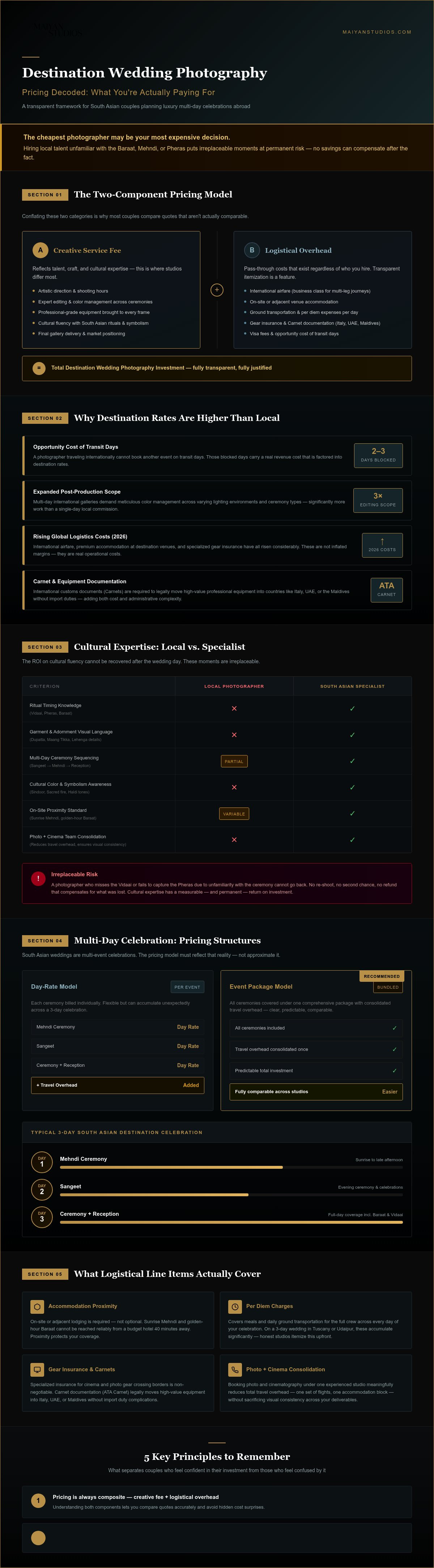
Strategic Budgeting for Multi-Day Destination Celebrations
A three-day South Asian wedding isn't three times the work of a single-day event. It's exponentially more complex. The scheduling dependencies between a Sangeet, Mehndi, wedding ceremony, and Reception create a layered logistical structure where crew rest, equipment turnaround, and location transitions all affect both coverage quality and destination wedding photographer pricing in ways that a standard quote rarely makes visible.
Calculating Coverage for Multi-Day Rituals
The two dominant pricing models for international multi-day commissions are day rates and event packages, and understanding the difference is essential before you sign anything. A day rate charges a fixed fee per calendar day, regardless of how many distinct events occur within it. An event package bundles specific ceremonies into a single quote, which can work in your favor when your Mehndi and Sangeet fall on the same day but creates friction when your schedule shifts.
Split days complicate both models. When a Mehndi runs until early afternoon and a Sangeet begins in the evening, the crew can't simply go home between events. They need to remain on-site, which means accommodation, meals, and equipment security during that gap are all active costs. Studios that don't account for split-day scheduling in their proposals are either inexperienced with South Asian timelines or deliberately underquoting to win the booking.
Pre-wedding and Day After sessions deserve a specific line in your budget rather than an afterthought. Iconic destination landscapes, whether a Tuscan vineyard at dawn or a Maldivian sandbank at low tide, offer visual opportunities that your ceremony day simply won't allow. Integrating engagement photo ideas into your destination package is almost always more cost-efficient than flying a team out separately, and the resulting images carry a different quality of intimacy that wedding-day coverage can't replicate.
Hidden Costs and Contingency Planning
Budget conversations tend to focus on planned expenses. The costs that genuinely surprise couples are the unplanned ones. Flight delays, rescheduled ceremonies, or weather disruptions at outdoor venues can extend a crew's on-site presence by a full day. Reputable studios build a contingency clause into their contracts; you should know what that clause covers and what it costs before you're in the middle of it.
On-site data backup is another line item worth understanding. Redundant hard drive copies made nightly protect your gallery if equipment is lost or damaged in transit. Some studios also offer instant-preview services, delivering a curated selection of images within hours of a ceremony for family sharing. These services carry real operational cost and are worth asking about explicitly.
When booking both photography and cinematography, consolidating under one studio is the clearest path to meaningful savings. Travel overhead, accommodation, and per diem costs are shared across the integrated team rather than duplicated across two separate vendors. That consolidation also eliminates the color and tonal inconsistencies that emerge when photo and video are edited in different studios with different aesthetic references.
Connect with Maiyan Studios to explore integrated multi-day coverage packages built around the full arc of your South Asian celebration.
Choosing Excellence: The Maiyan Studios Global Wedding Experience
Every element covered in this guide, from separating creative fees and logistical overhead to understanding the irreplaceable value of cultural fluency, points toward the same conclusion: destination wedding photographer pricing only makes sense when the studio behind it can actually deliver on what it promises. Maiyan Studios is built around exactly that standard.
Specializing exclusively in luxury South Asian weddings worldwide, Maiyan Studios brings an integrated photography and cinematography team to each commission. That integration matters practically. When one studio manages both disciplines, travel overhead is shared rather than duplicated, and the visual language across your gallery and your film stays coherent from the Mehndi through the Reception.
Bespoke Quotes for Worldwide Celebrations
No two destination weddings carry the same logistical profile. A Sangeet in a Florentine villa operates differently from a Nikah on a Maldivian overwater terrace, and the quote for each should reflect that. Maiyan Studios tailors every package to the specific venue, itinerary structure, and ceremonial sequence of your celebration rather than applying a generic day-rate formula. Permit requirements, crew accommodation proximity, split-day scheduling, and carnet logistics are all addressed before a proposal is presented, not discovered afterward.
Cultural authenticity isn't a feature Maiyan Studios adds to a standard luxury offering. It's the foundation the entire service is built on. The team arrives knowing the visual and emotional architecture of Hindu, Sikh, and Muslim ceremonies, which means no moment is treated as a photo opportunity rather than a sacred ritual. That's the Maiyan Studios promise: global vision with a heritage heart.
Securing Your 2026 Destination Date
International destination weddings require a planning window that most couples underestimate. Booking a specialist studio 12 to 18 months in advance is the realistic standard for 2026 celebrations. That lead time isn't administrative caution; it's what allows the team to coordinate travel logistics, secure permits at regulated venues, and, where possible, conduct site visits or detailed remote planning sessions before your wedding week begins.
Maiyan Studios' remote planning process is structured to reduce the friction of cross-timezone coordination. Venue walkthroughs, ceremony timeline reviews, and cultural briefings are handled systematically so that by the time the team arrives at your destination, the preparation is already complete.
If you're ready to move from planning to booking, inquire about our destination wedding photographer packages for 2026 and begin the conversation with a team that treats your celebration as the singular, irreplaceable event it is.
Your Destination Wedding Deserves a Team That Gets It Right the First Time
Destination wedding photographer pricing makes complete sense once you understand what it actually covers: a specialist creative fee, transparent logistical overhead, and the cultural fluency that protects moments you can never recreate. Those three elements, working together, are what separate a gallery you'll treasure from one you'll regret.
The clearest lesson from everything covered here is that the cheapest quote rarely reflects the true cost of getting it wrong. Cultural expertise, integrated photography and cinematography, and meticulous international logistics aren't premium add-ons; they're the baseline for a multi-day South Asian celebration documented properly.
Maiyan Studios brings all of that to every commission, from intimate ceremonies in Dubai to multi-day celebrations at Lake Como, with a team that specializes exclusively in luxury South Asian weddings worldwide. You don't have to piece together vendors across time zones or hope a generalist figures it out on the day.
Your celebration is singular and irreplaceable. Plan your global celebration with Maiyan Studios and begin your 2026 journey with a team that's ready for every moment of it.
Frequently Asked Questions About Destination Wedding Photographer Pricing
Do I have to book the photographer's flights and hotel myself?
No. Reputable studios handle their own travel logistics independently. You'll typically receive an itemized breakdown of travel costs as part of your quote, but the studio coordinates its own flights, accommodation, and ground transportation. This protects both parties: the studio ensures its team meets its own operational standards, and you're not liable for booking errors or last-minute itinerary changes that affect the crew.
Why are destination wedding packages more expensive than local ones?
Destination wedding photographer pricing reflects costs that simply don't exist for local commissions. International airfare, accommodation for multiple days, per diem expenses, gear carnets, and location permits all add operational overhead before a single frame is captured. Beyond logistics, the scope of work itself expands considerably: multi-day coverage, complex lighting environments across different venues, and post-production for a larger international gallery all require more time than a single-day local booking.
What happens if there are travel delays or visa issues with the team?
Professional studios with genuine international experience build contingency planning into their contracts before these situations arise. Ask any studio you're considering how they handle flight disruptions, delayed visa approvals, or force majeure events. A well-structured contract should define what coverage alternatives or compensation apply if the team can't arrive as scheduled. Studios that book travel well in advance and handle their own documentation reduce the probability of these scenarios significantly.
Is it cheaper to hire a local photographer in the destination country?
The travel fee savings are real, but they don't tell the full story. For South Asian couples celebrating ceremonies like a Baraat, Pheras, or Vidaai abroad, a local generalist photographer may lack the cultural fluency to anticipate and document those rituals accurately. The financial saving on travel costs can be offset entirely by missed moments that can't be re-shot. For culturally complex multi-day celebrations, the return on importing a specialist is measurable in the quality of what you actually receive.
How many people are typically on a luxury destination photography team?
Team size varies by studio and the scope of your celebration, but a luxury integrated team typically includes a lead photographer, a second photographer, a lead cinematographer, and a second cinematographer. Some studios add a dedicated lighting technician for larger venues or evening receptions. For a three-day South Asian wedding, having multiple team members working simultaneously across different ceremonies and family moments is what ensures nothing is missed while the lead photographer is covering the main ritual.
Does destination wedding photographer pricing include the pre-wedding shoot or just the wedding days?
Pre-wedding and Day After sessions are usually quoted as separate additions rather than included by default. That said, integrating a pre-wedding shoot into your destination package is almost always more cost-efficient than flying the team out on a separate trip, since travel overhead is already accounted for. Ask your studio explicitly whether engagement or pre-wedding sessions can be bundled into your destination quote, and confirm whether an additional day rate applies.
Are travel days included in the coverage hours?
Travel days are generally not counted as coverage hours, but they do carry a cost. Most studios charge a travel day rate that's lower than a full shooting day rate to compensate the team for their time and availability. On a long-haul international commission, there may be one or two travel days on each end of the trip. Reviewing how your studio structures travel day fees in the proposal is a straightforward way to avoid surprises in your final invoice.
What is a per diem, and do I pay it for every crew member?
A per diem is a daily allowance covering meals and local ground transportation for each crew member while they're on location. It applies across every day the team is present, including travel days, and yes, it typically covers each individual on the crew rather than the team as a whole. This is one reason why consolidating photography and cinematography under a single studio is a practical budgeting advantage: shared accommodation and coordinated logistics reduce the per-person overhead compared to managing two separate vendor teams.
Comments