
Cinematic vs. Documentary Wedding Film: Choosing Your Legacy in 2026
- Maiyan Studios
- Jun 1
- 13 min read
Updated: Jun 5
If you had to choose between a visually stunning three minute movie of your wedding and a complete record of every sacred ritual, which one would you sacrifice? It's a common dilemma for couples planning luxury celebrations, especially when deciding on a cinematic vs documentary wedding film. You're likely balancing the desire for high-end production with the need to preserve complex, multi-day traditions. You don't want to lose the emotional depth of your vows to a generic edit, but you also don't want a long, unpolished video that sits unwatched on a hard drive.
Choosing your film style is about more than just picking a look; it's about how you want to experience your legacy. You'll discover the essential differences between these two approaches so you can select the perfect storytelling method for your celebration. We'll break down the industry jargon and explain how a sophisticated hybrid approach ensures your South Asian or multicultural wedding is captured with both editorial flair and authentic detail. This guide covers everything from audio-first narratives to the latest high-art trends in 2026, helping you feel confident that your investment results in a timeless masterpiece.
Key Takeaways
Understand the fundamental difference between the "movie" approach and the "time capsule" record to align your film with your personal priorities.
Learn why the cinematic vs documentary wedding film debate often leads luxury couples to a hybrid style that combines high-art visuals with authentic ritual preservation.
Explore how high-end cinematography equipment and non-linear storytelling transform your wedding day into a sophisticated, editorial-style masterpiece.
Discover why documentary-style coverage is essential for South Asian weddings to ensure every cultural ritual and family interaction is captured for future generations.
Identify the specific elements that allow a film to balance cinematic flair with a thorough record of your luxury celebration.
Table of Contents
Defining Cinematic vs. Documentary Wedding Films for 2026
The decision between a cinematic vs documentary wedding film often feels like a choice between two different worlds. One offers the high-gloss polish of a Hollywood production, while the other serves as a faithful archive of every heartbeat and vow. As we move through 2026, the lines between these styles have blurred thanks to incredible advancements in camera technology. High resolution and professional color tools are now standard, but the core intent of each philosophy remains as distinct as ever. Understanding these differences is the first step in ensuring your luxury celebration is captured in a way that resonates for decades.
While The Basics of Videography often focus on the simple act of recording an event, modern wedding cinematography has evolved into a sophisticated art form. For luxury South Asian weddings, this distinction is particularly sharp. These celebrations are rich with complex rituals that require a careful balance of artistic flair and literal documentation. You shouldn't have to choose between a beautiful film and a complete one. Instead, you should understand how each style serves your family’s legacy and how they can be woven together to tell a complete story.
What is a Cinematic Wedding Film?
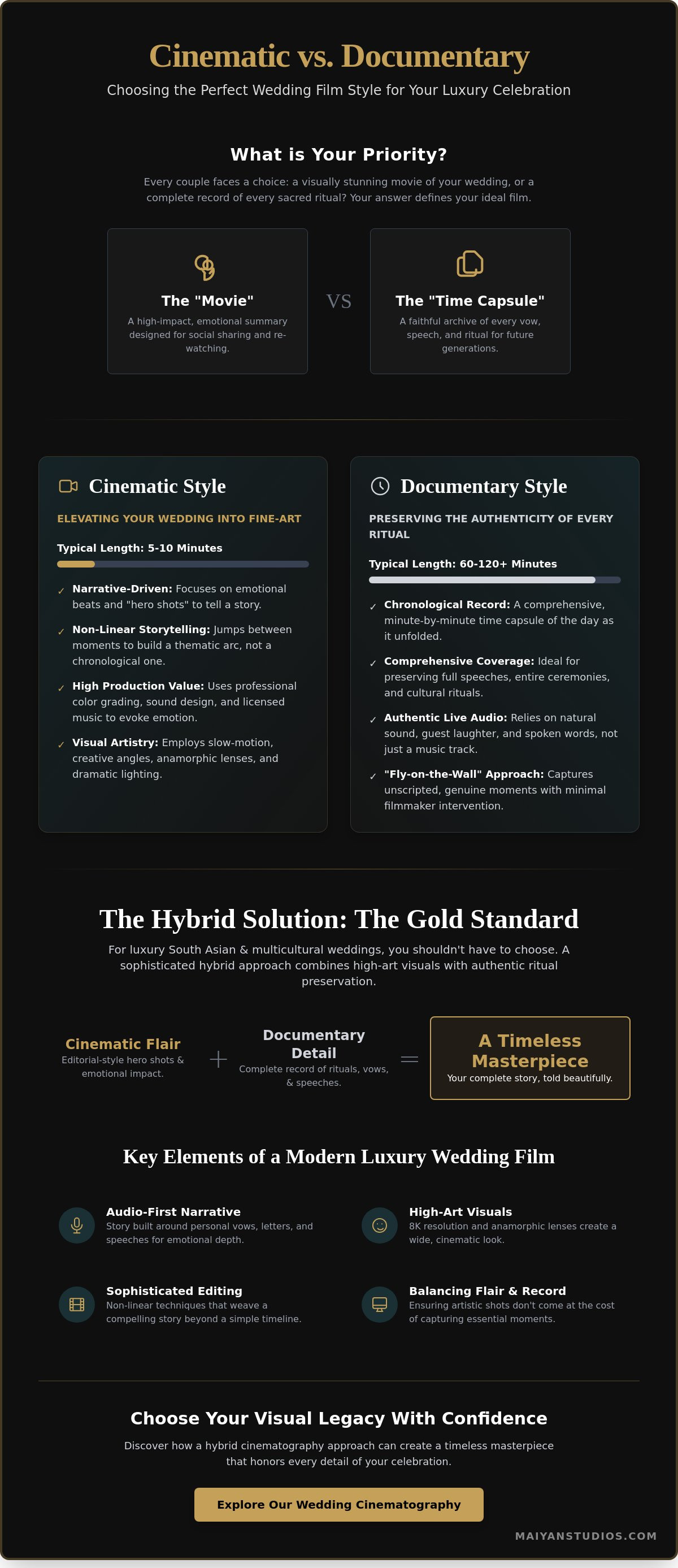
A cinematic wedding film is a narrative-driven experience. It typically results in a 5 to 10 minute highlight film that feels like a trailer for a high-budget movie. The focus here is on emotional beats and "hero shots" rather than a strict timeline. This style uses several specific techniques to elevate the footage:
Non-linear storytelling: The edit might jump from the morning preparations to the reception speeches to build a specific thematic arc.
Production Value: Editors use professional color grading, sound design, and carefully selected music to evoke specific feelings.
Visual Artistry: Expect slow-motion sequences, dramatic lighting, and creative angles that prioritize the "vibe" of the celebration.
What is a Documentary Wedding Film?
In contrast, a documentary wedding film acts as a chronological time capsule. Often spanning 60 to 120 minutes, this style captures the day as it unfolded, minute by minute. It’s less about artistic manipulation and more about preserving the raw, authentic energy of the event. Key features include:
Comprehensive Coverage: This format is ideal for preserving full speeches, entire religious ceremonies, and long-form cultural rituals.
Live Audio: The film relies heavily on natural sound, such as the laughter of guests or the specific words spoken during a South Asian ceremony.
Authenticity: The videographer takes a "fly-on-the-wall" approach, staying out of the way to capture unscripted moments as they happen.
The Cinematic Style: Elevating Your Wedding into Fine Art
A cinematic film isn't just a recording; it's a sensory experience designed to make you feel the weight of every moment. While the cinematic vs documentary wedding film choice often centers on length, the true distinction lies in the artistic intent. Cinematic films use high-end techniques to transform your celebration into a high-definition narrative. By utilizing 8K resolution and anamorphic lenses, cinematographers achieve a wide, letterboxed look that mimics the aspect ratio of modern blockbusters. This level of production value ensures that your film feels like a piece of fine art rather than a simple home movie.
The Art of Cinematography involves more than just pointing a camera. It requires professional lighting and meticulous sound design to create depth. Cinematographers layer your personal vows, private letters, and the ambient noise of the crowd to build a rich, auditory landscape. This approach makes these films the preferred choice for social sharing, as they provide a high-impact, emotional summary that's easy to watch and re-watch. If you're looking for a way to showcase the grandeur of your day, exploring professional wedding cinematography is the best place to start.
Storytelling Beyond the Timeline
The magic of a cinematic edit happens in the post-production suite. Instead of following the day from morning to night, editors use non-linear storytelling to build a specific emotional arc. They might open the film with a poignant line from a father’s toast or a groom’s reaction during the first look. This "Narrative Anchor" guides the viewer through the day's highlights, allowing the editor to condense approximately 30 hours of raw footage into a tight, 8-minute masterpiece. This structure prioritizes the soul of the wedding over a literal clock, ensuring every second on screen serves the story of your relationship.
Production Value and Visual Grandeur
Luxury celebrations, particularly destination weddings, demand a grand visual scale. Cinematographers use drones to capture epic venue reveals and the surrounding landscape, providing a sense of place that traditional filming can't match. For South Asian weddings, the cinematic style is particularly effective at highlighting intricate details. Slow-motion techniques allow the camera to linger on the sparkle of heavy jewelry, the texture of silk fabrics, and the detailed patterns of bridal henna. Professional color grading further enhances the mood, using vibrant, saturated tones for a high-energy Sangeet and softer, more ethereal palettes for the ceremony.
The Documentary Approach: Preserving the Authenticity of Every Ritual
In the discussion of a cinematic vs documentary wedding film, the term "documentary" is often misunderstood as being synonymous with raw, unedited footage. In 2026, this couldn't be further from the truth. A professional documentary film is a meticulously crafted record that prioritizes heritage over artistic manipulation. It isn't a lower quality option than a cinematic edit; rather, it uses the same high-end 8K sensors and professional audio equipment to act as a historian for your family. For luxury South Asian celebrations, this approach is often non-negotiable because it ensures every sacred ritual is preserved in its entirety.
The true value of the documentary style lies in its commitment to the truth of the day. While a cinematic highlight might show a three-second clip of a father’s toast, the documentary version preserves the full five-minute speech. This allows future generations to hear the tone of a loved one's voice and the specific stories that made the room laugh. It’s an archival philosophy that views the wedding not just as a party, but as a landmark event in a family’s history. When you're choosing between a cinematic vs documentary wedding film, consider if you want a poem or a biography. Both are beautiful, but they serve very different purposes for your legacy.
Capturing the Full Cultural Context
South Asian weddings are a tapestry of fast-moving traditions like the Milni or deeply spiritual moments like the Phera. A documentary approach ensures these nuances aren't lost to a creative edit. It captures the "unseen" moments that define the day, such as a grandmother’s quiet blessing or the spontaneous laughter during a Jago. A 90-minute documentary film serves as a living family heirloom, capturing the voices and laughter of loved ones in a way a short highlight reel simply cannot. By focusing on the full cultural context, you preserve the "why" behind every gesture, creating a record that grows more valuable with each passing decade.
The Long-Form Edit: What to Expect
The structure of a documentary film follows a strictly chronological flow. It begins with the intimate pre-wedding rituals and concludes with the emotional finality of the Vidaai. To achieve this, cinematographers use complex multi-camera setups, often involving three or more units to capture the officiant, the couple, and the parents simultaneously. In the 2026 production environment, this requires perfect synchronization of high-fidelity audio and video streams across all angles. You might choose between a "Legacy Edit," which includes every minute of the ceremony and speeches, or a slightly more condensed "Feature Film" that maintains the chronological order while removing technical pauses. Both options provide a level of depth that artistic highlights don't have the space to include.
The Hybrid Solution: Why Same Day Edits are the MOFU Gold Standard
While the debate over a cinematic vs documentary wedding film often focuses on final delivery months later, the Same Day Edit (SDE) offers immediate gratification. It’s a high-energy, cinematic highlight film edited on-site and premiered during your reception. This serves as the ultimate bridge between styles. It captures the raw emotion of the morning's rituals and presents them with the polish of a feature film before the night is over. For luxury South Asian weddings, where the ceremony and reception are often separated by hours or different venues, the SDE acts as a unifying narrative thread for your guests.
Producing an SDE is a massive logistical undertaking. It requires a dedicated on-site editor who works in a mobile suite while the cinematographers continue to shoot. High-speed data transfers and 2026-standard processing power allow the team to ingest 8K footage and color grade it in real-time. This isn't just a slideshow; it's a fully realized movie trailer for your day. It solves the pain of waiting months to see a high-quality edit while still allowing for a comprehensive documentary record to be finished later. This ensures you don't have to sacrifice speed for production value.
Same Day Edit vs. Traditional Highlights
The emotional impact of an SDE is unmatched. Watching your ceremony footage just hours after it happened, surrounded by your closest family and friends, creates a shared experience that a traditional highlight film cannot replicate. It also serves as essential entertainment for guests who might have missed the morning rituals or pre-wedding events like the Sangeet. To pull this off, your team needs more than just talent. They need a specific technical infrastructure, including dedicated editors and the ability to manage massive amounts of data under high-pressure deadlines.
Integrating the SDE into Your Full Package
A Same Day Edit isn't a replacement for your final film; it's the first chapter. It serves as a high-impact teaser that keeps the excitement alive while the studio prepares your full cinematic vs documentary wedding film options. Many luxury couples now opt for a hybrid approach. They receive the cinematic SDE for immediate sharing and reception impact, paired with a long-form documentary record for historical preservation. Maiyan Studios are recognized specialists in high-pressure SDE delivery, ensuring that even the most complex multi-day schedules are distilled into a breathtaking reception premiere.
Ready to elevate your reception with a cinematic masterpiece created in real-time? Explore our wedding cinematography packages to see how a Same Day Edit can transform your celebration.
Choosing Your Visual Legacy: The Maiyan Studios Philosophy
Deciding on a cinematic vs documentary wedding film shouldn't feel like a compromise between artistic beauty and cultural preservation. At Maiyan Studios, we believe these two approaches are not mutually exclusive. Our philosophy centers on creating an effortless, elevated, and deeply personal film that captures both the grand scale of your luxury celebration and the intimate, unscripted moments that define your family's heritage. By blending editorial flair with a commitment to archival thoroughness, we ensure that your wedding film serves as both a high-art masterpiece and a faithful time capsule for future generations.
A successful wedding film requires more than just high-end equipment. It requires a deep understanding of the emotional weight behind each ritual. Whether we're filming a destination wedding or a multi-day South Asian celebration, our goal is to maintain a consistent visual narrative. We focus on the "soul" of the event, ensuring that the final product reflects your unique personality while honoring the traditions that matter most to your family. This balanced approach is why many luxury couples now choose a hybrid model that provides the best of both worlds.
For those inspired by this philosophy, One Vision Photography | South Wales Wedding Photographer serves as an excellent example of an award-winning team that successfully integrates photography and videography to create a unified and timeless legacy.
The Power of the Unified Team
One of the most effective ways to ensure a seamless visual legacy is by hiring a single creative team for both photography and video. When you book luxury wedding cinematography alongside photography, you eliminate the risk of different vendors competing for the same physical space. A unified team operates under a single artistic direction, resulting in aesthetic consistency across your entire gallery and film. This coordination is especially vital in complex environments where timing is everything. For a deeper look at how we approach these visuals, you can explore our guide on South Asian wedding photography styles.
Questions to Ask Before Booking
Before you commit to a studio, it's essential to audit their portfolio for more than just surface-level beauty. Many videographers can produce a stunning three-minute teaser, but the true test of a professional is their ability to deliver a coherent long-form edit. Consider asking these specific questions during your interviews:
Do you offer a long-form documentary edit alongside the cinematic highlight film?
How many shooters are included in the package to ensure every ritual is covered from multiple angles?
Can I see a full-length documentary film from a previous wedding, not just the highlight reel?
How do you handle the technical challenges of capturing live audio during loud ceremonies or reception speeches?
The right team will be transparent about their process and excited to show you the depth of their work. If you're ready to define your own visual legacy, book a consultation with Maiyan Studios to discuss a custom wedding film strategy for your celebration.
Defining Your Story for Generations to Come
Your wedding film is more than just a video; it's a legacy that will be viewed by your children and grandchildren. Whether you lean toward the artistic flair of a cinematic edit or the thorough record of a documentary style, the most important factor is finding a balance that honors your unique story. The cinematic vs documentary wedding film debate isn't about which style is better. It's about which approach preserves your most cherished memories with the depth they deserve. By choosing a team that understands the nuances of multi-day South Asian luxury weddings, you ensure every ritual is captured with award-winning storytelling and global expertise.
We've looked at how high-end production value and chronological archiving can coexist to create a comprehensive record of your day. From the epic scale of destination wedding coverage to the high-pressure delivery of a same day edit, your choice should reflect the soul of your celebration. Ready to see these styles in action? We invite you to view our portfolio of cinematic and documentary wedding films to find the perfect fit for your upcoming celebration. Your wedding deserves a film as timeless and grand as the day itself.
Frequently Asked Questions
What is the main difference between cinematic and documentary wedding videography?
The main difference between a cinematic vs documentary wedding film lies in the storytelling perspective and editing style. Cinematic films focus on an emotional, narrative arc using movie-like techniques such as non-linear editing and stylized color grading. Documentary films prioritize a chronological record of events, acting as a faithful time capsule that captures the day exactly as it unfolded without artistic manipulation of the timeline.
How long is a typical cinematic wedding film vs. a documentary film?
A typical cinematic film ranges from 5 to 10 minutes, while a documentary film usually lasts between 60 and 120 minutes. The cinematic version is a high-impact highlight reel designed for repeated viewing and sharing. In contrast, the documentary edit provides a comprehensive archive, ensuring that long-form cultural rituals and full religious ceremonies are preserved in their entirety for future generations to watch and appreciate.
Is a same day edit wedding video worth the extra cost?
A same day edit is often considered a high-value investment for luxury celebrations because it provides immediate emotional impact at the reception. It serves as a premier entertainment piece for guests, especially those who couldn't attend morning rituals. While it requires a larger on-site team and dedicated editing hardware, the ability to share a polished, cinematic version of your vows just hours after they happened is a unique experience.
Can I have both a cinematic highlight and a documentary edit?
You can certainly have both a cinematic highlight and a documentary edit, and this hybrid approach is standard for luxury wedding cinematography. Most high-end studios provide a short, artistic film for social sharing and a separate, long-form edit that includes full speeches and ceremonies. This cinematic vs documentary wedding film combination ensures that you don't have to choose between a visually stunning story and a complete historical record.
How many videographers are needed for a cinematic South Asian wedding?
A cinematic South Asian wedding typically requires at least three videographers to ensure comprehensive coverage of complex rituals. Multiple operators are necessary to capture the couple's reactions, the parents' emotions, and the intricate details of the ceremony simultaneously. For large-scale luxury events with hundreds of guests, additional shooters may be needed to manage the scale of the celebration and ensure no sacred moment is missed across different locations.
Do cinematic wedding films include the full ceremony and speeches?
Cinematic wedding films generally don't include the full ceremony or every minute of the speeches. Instead, they use carefully selected audio snippets and visual highlights to build a compelling narrative. If you want to hear every word of your vows or see the entire toast from your best man, you should ensure your package includes a documentary-style long-form edit alongside your cinematic highlight to preserve those details.
What is a "Same Day Edit" and how does it work?
A Same Day Edit (SDE) is a short film created from footage captured earlier that same day and shown during the reception. A dedicated editor works behind the scenes to ingest, cut, and color-grade the morning's highlights while the wedding is still in progress. It requires high-speed data management and a synchronized team to deliver a professional, movie-quality production before the final cake cutting or the start of the dance party.
Which style is better for sharing on Instagram and TikTok?
The cinematic style is significantly better for sharing on platforms like Instagram and TikTok due to its high production value and fast pacing. These films are designed to grab attention quickly with "hero shots," dramatic music, and professional color grading. While documentary clips can be used for raw "behind-the-scenes" content, the polished look of a cinematic highlight better suits the aesthetic expectations of modern social media audiences.


Comments