
Cinematic vs. Documentary Wedding Film: Choosing the Right Style for Your 2026 Celebration
Will your wedding film be a breathtaking work of art that leaves out the heart of your heritage, or a record of every ritual that feels more like a home movie than a masterpiece? You want a film that captures the grand, emotional scale of your union without sacrificing the intricate details of your three-day celebration. It's a difficult balance to strike, especially when you're planning a luxury event for 2026. You likely worry that a short edit will miss a crucial moment of the Pithi or that a longer version will feel dated and slow.
Understanding the nuances of a cinematic vs documentary wedding film is the first step toward making a confident decision for your legacy. This article will help you discover the stylistic differences between these two approaches so you can decide how your South Asian heritage should be preserved. We'll explore how to blend high-end production values with ritual accuracy and provide a clear plan for managing multi-day coverage that justifies your investment.
Table of Contents
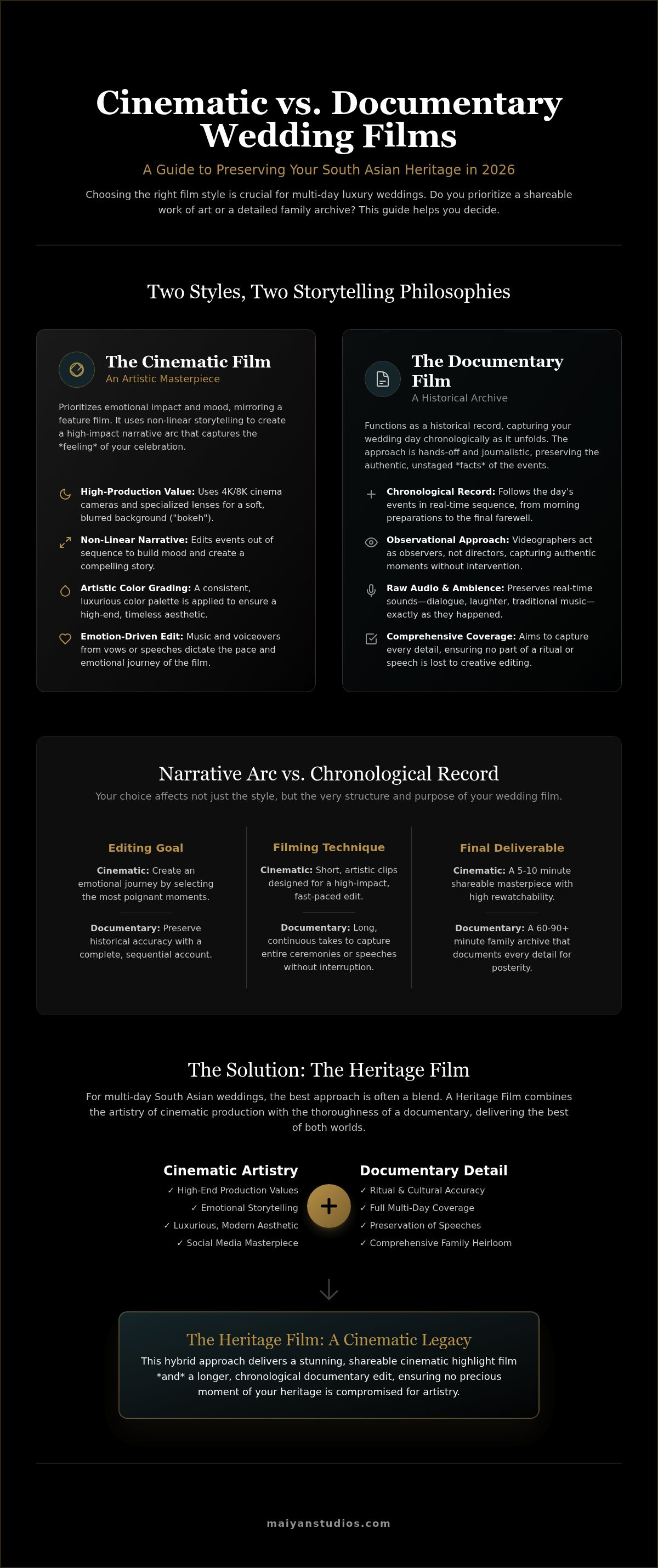
Cinematic vs. Documentary Wedding Films: Defining the 2026 Visual Standard
Narrative Arc vs. Chronological Record: A Comparative Analysis
The Cultural Lens: Applying These Styles to Multi-Day South Asian Weddings
Choosing Your Style: A Selection Framework for Luxury Couples
The Maiyan Studios Signature: A Cinematic Legacy for Your Heritage
Cinematic vs. Documentary Wedding Films: Defining the 2026 Visual Standard
The standard for wedding media has shifted dramatically. By 2026, the era of the grainy, unedited "home movie" is officially over. For luxury couples, a wedding film is no longer just a recording; it's a high-stakes production. Deciding between a cinematic vs documentary wedding film is the most important creative choice you'll make during your planning process. This decision dictates how your multi-day rituals, emotional vows, and grand celebrations will be remembered for generations.
Luxury weddings, particularly those within South Asian heritage, involve a complex layer of traditions that require a sophisticated lens. You aren't just choosing a camera operator; you're choosing a storyteller. One style focuses on the "feeling" of the day, while the other focuses on the "facts." Understanding these distinct approaches ensures that your investment results in a film that aligns with your personal taste and family expectations.
What Makes a Film "Cinematic"?
Cinematic wedding films are defined by high-production values that mirror the look and feel of a feature film. This style relies on cinema-grade 4K or 8K cameras and specialized lenses that create "bokeh," that soft, blurred background that makes the subjects pop. Editors use non-linear storytelling, meaning they might show the reception decor before the morning preparations to build a specific mood or narrative arc.
Visual Artistry: Heavy focus on color grading to create a consistent, luxurious aesthetic.
Narrative Tools: Use of voiceovers from vows or speeches to drive the story forward.
Music Integration: The soundtrack is carefully curated to evoke specific emotions, often dictates the pace of the edit.
Cinematic cinematography is a deliberate art form that prioritizes mood and emotional resonance over the total number of minutes recorded.
The Essence of Documentary Videography
If cinematic films are movies, documentary wedding films are historical archives. This style, often called "wedding photojournalism," follows a chronological record of the day as it happened. The videographer takes a hands-off approach, acting as an observer rather than a director. They capture authentic, unstaged moments without asking you to repeat a movement or pose for the camera.
The beauty of this style lies in its honesty. It preserves the real-time pacing of events, from the laughter during the Baraat to the quiet, tearful moments of the Vidaai. You'll hear raw audio and ambient sounds, like the rustle of a heavy lehenga or the specific melody of a traditional song, exactly as they sounded in the moment. It's a journalistic approach that ensures no detail of your heritage is lost to creative editing.
Narrative Arc vs. Chronological Record: A Comparative Analysis
Choosing between a cinematic vs documentary wedding film often comes down to how you want to feel when you press play ten years from now. A cinematic approach builds a narrative arc. It selects the most poignant whispers, the loudest cheers, and the most dramatic glances to create an emotional journey. In contrast, a documentary record prioritizes historical accuracy. It captures the full sequence of events, ensuring that nothing is omitted, even if it doesn't fit a specific "story."
Filming techniques differ just as sharply. Cinematic videographers focus on short, artistic clips designed for a high-impact edit. They might spend minutes setting up a single shot of a veil catching the light or a slow-motion walk. Documentary creators opt for long, continuous takes. They want to capture the full exchange of a ceremony or the entire length of a speech without interruption. This choice affects the final "feel" of your media. You're choosing between a five-minute masterpiece that captures the soul of the event or a sixty-minute archive that documents every second.
Emotional Impact and Long-Term Value
Cinematic highlights have high rewatchability. They're designed to be shared on social media and viewed annually on anniversaries because they condense the energy of a multi-day celebration into a digestible, high-octane format. The color grading in these films is essential for preserving a luxury aesthetic; it ensures the vibrant colors of a bridal lehenga or the intricate gold of a mandap look consistent and expensive.
Documentary edits offer a different kind of value. They serve as a family archive. For future generations, seeing the full, unedited interaction between elders or hearing the live, ambient sound of traditional music provides a literal connection to family history. Many couples find that investing in professional wedding cinematography allows them to secure both an emotional highlight and a comprehensive record of their heritage.
Equipment and Presence on the Wedding Day
The gear used often dictates how much you'll notice the crew. Cinematic filming requires tools for dynamic movement, like drones, gimbals, and sliders. These allow for those sweeping shots that make a film feel like a big-budget production. Documentary setups are usually more discreet. They rely on handheld setups or tripods for a "fly-on-the-wall" presence.
Cinematic Presence: Often involves more movement and direction from the crew to capture specific artistic angles.
Documentary Presence: Focuses on being unobtrusive, capturing moments as they naturally unfold.
Crew Size: Luxury productions may use multiple operators to cover both styles simultaneously without overcrowding the space.
Balancing the number of creators is vital for a luxury atmosphere. You want high-end production values, but you don't want your guest experience ruined by a dozen camera operators. A specialized team knows how to use cinema-grade equipment while remaining unobtrusive, ensuring the focus remains on your rituals rather than the technology surrounding them.
The Cultural Lens: Applying These Styles to Multi-Day South Asian Weddings
Standard highlight reels often fail to capture the gravity of a luxury South Asian wedding. When your celebration spans three or more days, a single five-minute edit simply can't hold the weight of your heritage. The choice between a cinematic vs documentary wedding film becomes more complex when you're managing a Sangeet, a religious ceremony, and a grand reception. Each event demands a different visual language to be effective. For example, planning for luxury Indian wedding photographer Dubai coverage requires a team that understands how to transition between these styles across distinct venues and traditions.
The Sangeet is a playground for cinematic energy. With choreographed dances and vibrant colors, the film needs fast-paced editing and dynamic camera movements to mirror the room's spirit. In contrast, the Anand Karaj or a traditional Hindu ceremony requires a shift toward documentary-style preservation. These moments are sacred. Cutting a religious ritual short just to fit a musical beat can strip the ceremony of its religious significance and leave elders feeling that the heart of the wedding was missed.
Ritual Accuracy vs. Artistic Flair
Preserving the Vidhi or the Pheras requires a journalistic eye. You need to ensure every step is documented for historical and religious accuracy, allowing the full sequence of the ritual to breathe. At the same time, you can use cinematic transitions to connect the narrative between the pre-wedding events and the main day. South Asian weddings benefit from a hybrid approach more than any other culture because they demand a perfect marriage between high-art storytelling and the literal archiving of ancient traditions.
The Grandeur of the Reception
The final night is often where the luxury scale is most visible. Capturing the vastness of the decor and high-energy performances works best with cinematic drone shots and sweeping gimbals that emphasize the production value. But when the speeches begin, the focus should return to documentary coverage. These raw family interactions and heartfelt words are what ground the film in reality. To understand how these elements come together into a cohesive story, exploring the fundamentals of wedding cinematography can provide deeper insight into the storytelling process.
Choosing Your Style: A Selection Framework for Luxury Couples
Selecting a production style isn't just about personal preference. It's about matching the visual language to the scale and setting of your event. For a multi-day South Asian celebration in 2026, you need a logical framework to decide between a cinematic vs documentary wedding film. Decisions made based on a "vibe" often lead to regret when you realize a key ritual was cut for the sake of a musical transition or a specific artistic shot.
First, evaluate your scale. A guest list of 400 or more people usually requires more documentary-style coverage. This ensures that important family members and the sheer volume of your celebration aren't lost in a highly stylized edit. Second, define your viewing goals. If your priority is a high-impact experience for social media, cinematic is the clear winner. However, if you want a historical record for future generations, documentary takes precedence. Third, consider your venue. Destination weddings in locations like Dubai, Bali, or Lake Como practically demand cinematic drone work to capture the grand architecture and landscapes. Fourth, review your ritual list. If you have numerous specific sub-rituals during the Vidhi or Pithi, you need a team that prioritizes documentary accuracy. Finally, discuss hybrid options with your creators to find a middle ground that captures both the heart and the history.
When to Choose Cinematic
Cinematic films are ideal for couples who want a "red carpet" feel. When weighing a cinematic vs documentary wedding film, this style is perfect for 2026 trends that focus on short-form, high-quality storytelling that packs an emotional punch. If you're hosting a destination wedding with epic scenery, cinematic techniques like slow-motion and artistic color grading will make your film look like a Hollywood production. It's the best choice if you want a film that's easy to share and rewatch every anniversary because it captures the essence of your love story in a polished, non-linear format.
When to Prioritize Documentary
Choosing to prioritize documentary coverage is a smart move for families where ritual tradition is the primary focus. It's best for large, traditional ceremonies where every guest interaction matters. Don't worry about the "home movie" look; professional documentary footage in 2026 still uses high-end editing and 4K resolution to maintain a luxury feel. It simply stays true to the real-time pacing of the day. If you're ready to plan your visual legacy, you can book your wedding cinematography consultation with our expert team to find the perfect fit for your heritage.
The Maiyan Studios Signature: A Cinematic Legacy for Your Heritage
Maiyan Studios approaches every celebration with a commitment to both visual beauty and cultural accuracy. We don't view the debate of a cinematic vs documentary wedding film as an either-or scenario. Instead, we've developed a signature style that combines high-production storytelling with the journalistic integrity required for multi-day South Asian events. This ensures that while your film looks like a cinematic masterpiece, it never loses the context of the rituals that define your family history.
Our "Heritage Film" concept is a bespoke solution for luxury couples who refuse to compromise. It prioritizes the emotional narrative of your relationship while creating a comprehensive archive of your celebration. By using a single team for both photo and video, we maintain a cohesive visual language across all your media. You can explore different South Asian wedding photography styles to see how we align our stills with our motion work for a unified, high-end aesthetic.
Bespoke Multi-Day Coverage
We tailor our crew size to the specific complexity of your itinerary. A high-energy Sangeet might require more mobile, cinematic operators to capture the dance floor's energy, whereas a traditional ceremony often benefits from additional fixed cameras to capture every religious detail from multiple angles. We also use pre-wedding sessions to establish the narrative foundation of your film. These sessions allow us to capture your personality in a relaxed setting, which we then weave into the final edit to add depth. If you're looking for inspiration, check out these engagement photo ideas to see how we begin building your cinematic story long before the wedding day.
Global Destination Expertise
Operating globally requires a deep understanding of international logistics and cultural nuances. Whether you're celebrating in Dubai, London, or a remote destination, we maintain cinema-grade production standards without compromise. We respect the weight of your traditions and ensure that your destination heritage is captured with the dignity it deserves. Navigating the world of high-end wedding media shouldn't be stressful; it should be an investment in a legacy that lasts forever.
Book your luxury wedding cinematography consultation with Maiyan Studios to start planning your 2026 legacy and ensure your story is told with the perfect balance of art and truth.
Preserving Your Visual Legacy for 2026 and Beyond
Choosing between a cinematic vs documentary wedding film is ultimately about deciding how you want your history to be told. Whether you prioritize the high-impact emotional narrative of a cinematic edit or the chronological integrity of a documentary record, your choice will shape how future generations experience your heritage. For luxury South Asian celebrations, the most successful films are those that bridge the gap between artistic storytelling and ritual accuracy. This ensures the vibrancy of your Sangeet and the sanctity of your ceremony are both captured with the respect they deserve.
As specialists in multi-day South Asian rituals, Maiyan Studios provides award-winning visual storytelling that captures the heart of your union. From Lake Como to Dubai, we offer global destination coverage that maintains high-end production values regardless of the location. You don't have to choose between art and truth when you have a team dedicated to preserving both. Capture Your Legacy with Maiyan Studios Luxury Cinematography and ensure your 2026 celebration is remembered exactly as it felt. Your story deserves to be a masterpiece.
Frequently Asked Questions
Is cinematic wedding videography more expensive than documentary?
Cinematic videography typically carries a higher investment due to the extensive post-production and high-end equipment involved. Editing a cinematic vs documentary wedding film requires more hours of color grading and sound design to create a narrative arc. While documentary styles focus on preserving raw footage, cinematic edits demand a meticulous selection process to ensure every frame contributes to the emotional story.
Can I have both cinematic and documentary styles for my wedding?
You can certainly have both styles by choosing a hybrid coverage package. Most luxury couples receive a cinematic highlight film for social sharing and a longer documentary edit that preserves the full ceremonies. This approach ensures you have a breathtaking artistic piece alongside a complete historical record of your family rituals without having to choose one over the other.
How long is a typical cinematic wedding highlight film?
A typical cinematic wedding highlight film ranges from five to ten minutes in length. This duration is designed to capture the emotional peaks and visual grandeur of the event without losing the viewer's attention. For multi-day celebrations, some studios offer extended cinematic features that reach 15 to 20 minutes to accommodate the additional events like the Sangeet and Mehndi.
Does a documentary wedding video include music or just live audio?
Documentary wedding films prioritize live, ambient audio to capture the authentic atmosphere of the day. While light instrumental music might be layered under certain segments, the primary focus remains on the real sounds of vows, laughter, and traditional music. This style ensures that the voices of your loved ones and the specific sounds of your rituals are preserved exactly as they happened.
Which style is better for a 3-day Indian wedding celebration?
A hybrid approach is the most effective style for a 3-day Indian wedding celebration. You need the cinematic energy to capture the vibrancy of the Sangeet and the grand reception, but the documentary style is essential for the religious ceremonies. This combination ensures that the fast-paced festivities look like a movie while the sacred rituals are documented with total accuracy for future generations.
Will a cinematic videographer tell us what to do or is it natural?
Cinematic videographers often provide light direction to ensure the lighting and composition are perfect for artistic shots. They might ask you to walk through a garden or adjust your veil, but they spend the majority of the time capturing natural, unscripted moments. This balance allows for high-end visual storytelling without making the day feel like a staged photo shoot.
How long does it take to receive a cinematic wedding film in 2026?
Delivery times for a cinematic wedding film in 2026 generally range from twelve to twenty-four weeks. The complexity of the editing process, especially for multi-day South Asian weddings, requires significant time to perfect the narrative and color grading. Some studios provide shorter teaser trailers within a few weeks of the celebration to satisfy the immediate desire for social sharing.
Do I need a drone for a cinematic wedding film?
While a drone is not mandatory, it's highly recommended for achieving a truly cinematic look at luxury or destination venues. Aerial footage provides a sense of scale and captures the grandeur of the architecture and landscape in a way that ground cameras cannot. It adds a high-production value that distinguishes a luxury film from a standard wedding video.
Comments