
Choosing the Ultimate Indian Wedding Videographer: A 2026 Luxury Buying Guide
- Maiyan Studios
- Jun 3
- 13 min read
Would you trust someone to document your legacy if they couldn't distinguish the sacred silence of the Anand Karaj from the high-energy chaos of a Sangeet? For a luxury South Asian celebration, a standard video isn't enough. You need an Indian wedding videographer who acts as a silent observer, capturing every ritual with cultural precision and cinematic flair. It's a common fear that a massive camera crew might disrupt the intimacy of your Pheras or miss a fleeting glance between parents during the Vidai.
We understand that you're looking for more than just a recording; you want a timeless heirloom that mirrors the grandeur of your multi-day event. This guide will show you how to master the art of selecting a world-class cinematography team that understands the intricate rituals and vibrant energy of luxury South Asian weddings. We'll break down the latest 2026 trends in cinematic storytelling and explain how to ensure seamless coordination between your photography and videography teams for a stress-free experience.
Key Takeaways
Learn how to distinguish between standard event recording and luxury cinematography that uses narrative storytelling to capture your legacy.
Vet your Indian wedding videographer for ritual intuition to ensure they're always prepared for key moments like the Pheras or Anand Karaj.
Identify 2026 technical non-negotiables, including 4K RAW capture and high-performance low-light clarity for grand reception ballrooms.
Master the logistics of multi-day scheduling and understand the timing required for high-pressure features like Same Day Edits.
Discover why hiring a unified team for both wedding photography and cinematography prevents coordination conflicts and ensures a consistent visual style.
Table of Contents
Beyond the Basics: Defining Luxury Indian Wedding Cinematography
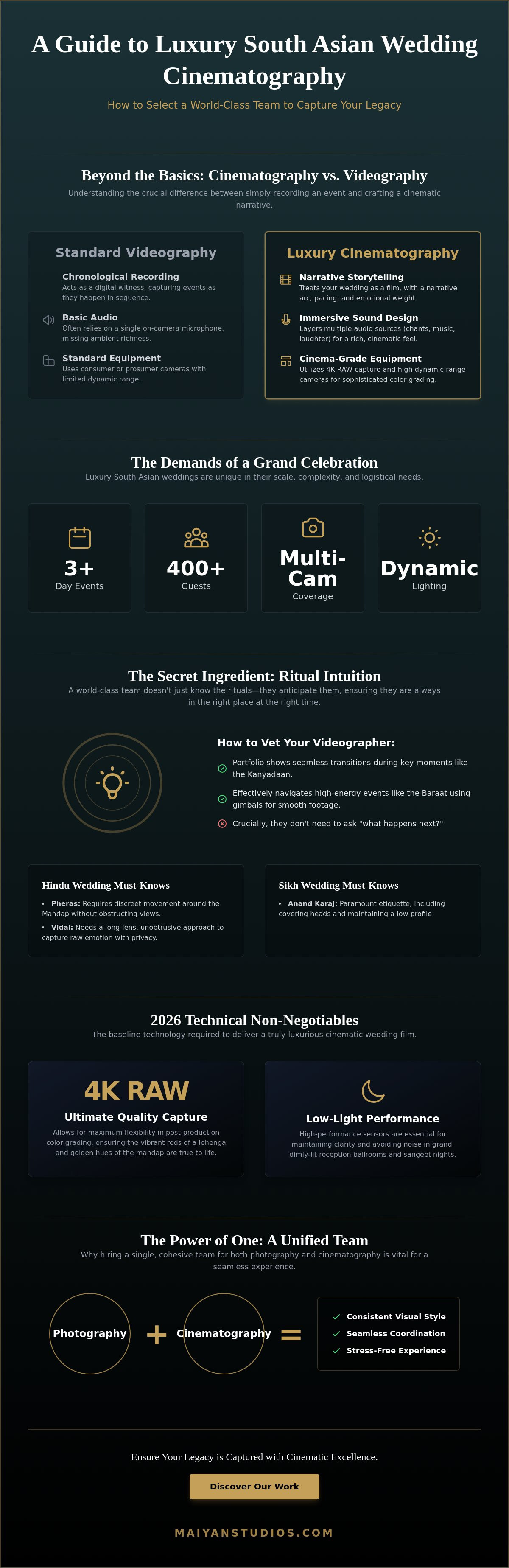
Indian wedding cinematography is the fusion of cultural ritual and cinematic narrative. While many people use the terms "videography" and "cinematography" interchangeably, the distinction is vital for couples planning a high-end celebration. A standard video records events chronologically, essentially acting as a digital witness. In contrast, luxury cinematography focuses on storytelling. It treats your wedding not just as a series of events, but as a cinematic production with a clear narrative arc that captures the emotional weight of your legacy.
Choosing an experienced Indian wedding videographer means investing in a team that understands how to balance these two worlds. They don't just stand in the corner with a camera. They curate a visual experience that highlights the vibrant energy of the Sangeet and the quiet, sacred moments of the ceremony. This level of production requires a deep understanding of pacing, emotion, and cultural significance.
Cinematography vs. Videography: What is the Difference?
The difference starts with the equipment. Professional cinematographers use cinema-grade cameras that offer high dynamic range and RAW capture capabilities. This technology allows for sophisticated color grading in post-production, ensuring the deep reds of a lehenga or the golden hues of the mandap look exactly as they did in person. Sound design is another critical differentiator. Instead of relying on a single on-camera microphone, a luxury team uses multiple audio sources to layer the sounds of the dhol, the priest’s chants, and the laughter of your guests.
In this context, the lead filmmaker acts more like a director. They guide the couple through wedding cinematography techniques that feel natural rather than staged. This proactive approach ensures that every frame serves the story, rather than just filling time on a hard drive.
Why Luxury Weddings Demand a Specialized Approach
South Asian weddings are unique in their scale and complexity. With guest counts often ranging from 300 to 400 people and events spanning three or more days, the logistical demands are immense. You can't capture the grandeur of a luxury ballroom or the intimacy of Hindu wedding rituals with a single camera operator. A specialized Indian wedding videographer employs multi-camera setups to cover simultaneous actions, such as the groom’s Milni and the bride’s final preparations.
Technical production also involves managing difficult lighting environments. Whether it's the low light of a high-energy reception or the harsh sun of an outdoor ceremony, a luxury team brings the necessary lighting rigs to maintain clarity without being intrusive. This specialized focus ensures that the scale of the celebration is preserved without losing the small, fleeting details that make your wedding yours.
The Cultural Competency Framework: Evaluating Experience with Rituals
Cultural competency is the backbone of high-end cinematography. It's not enough to have expensive gear if the crew doesn't understand the sequence of a ceremony. An elite Indian wedding videographer demonstrates "ritual intuition," the ability to be in the right place before a significant moment occurs. You can test this by looking at how they handle the transitions between rituals in their portfolio. Do they capture the subtle hand-offs and glances during the Kanyadaan, or do they seem to be catching up to the action? If a team has to ask what happens next, they aren't ready for a luxury South Asian wedding.
Managing the Baraat requires a specific set of skills. It is a whirlwind of music, dancing, and constant movement. An experienced Indian wedding videographer knows how to use gimbals and stabilizers to keep footage smooth while navigating through a crowd of hundreds. They prioritize the groom's experience while documenting the joy of the families, ensuring the energy translates perfectly to the screen without the camera crew becoming an obstacle.
The Key Rituals Your Videographer Must Know
Hindu Wedding: The Pheras require a videographer to move around the Mandap without obstructing the view of the family. The Vidai, being a deeply emotional part of the day, needs a long lens approach to capture raw feelings without intruding on the family's privacy.
Sikh Wedding: Etiquette is paramount during an Anand Karaj. A knowledgeable team knows to cover their heads and remain seated or low to the ground to respect the Guru Granth Sahib.
Pre-wedding events: The Sangeet and Mehndi are tests of lighting and audio. These events are often dark and loud, requiring a team that can manage high-energy performances without losing visual clarity or sound quality.
Communication and Etiquette During the Ceremony
Respecting the sacred space is non-negotiable. A professional crew coordinates with the priest or officiant ahead of time. This ensures they know the specific boundaries of the Mandap or altar. By building this rapport, the team can capture intimate shots without causing a distraction. This level of professionalism is what separates luxury services from standard ones. If you're looking for a team that understands these nuances, you can explore our specialized wedding cinematography services to see how we handle these sacred spaces.
When evaluating a portfolio, look for how the team handles different South Asian wedding photography styles and video edits. The best films show a deep respect for the culture, balancing the scale of the celebration with the sanctity of the rituals. They don't just record the event; they preserve the atmosphere and the specific traditions that make your family's story unique.
Technical Standards for 2026: What to Look for in a Portfolio
In 2026, the technical floor for luxury cinematography has shifted significantly. It’s no longer enough for a film to simply look "nice" on a phone screen. A top-tier Indian wedding videographer now utilizes 4K RAW capture as a standard practice. This high-resolution format ensures your wedding film maintains its clarity on the massive 8K and 16K displays of the future. RAW data allows for much greater flexibility during the editing process, ensuring that the intricate details of a gold-threaded sherwani or the subtle sparkle of a diamond necklace are preserved with lifelike precision.
When you review a portfolio, pay close attention to the "Low Light Test." Luxury South Asian receptions often feature dramatic, moody lighting that can result in grainy or "noisy" footage if the team isn't using professional-grade sensors. Look at the shadows in the reception clips. The footage should remain crisp and clear even when the ballroom is dimmed for the first dance or the high-energy performances. If the image looks muddy or pixelated in dark environments, the equipment or the operator isn't meeting luxury standards.
Audio is the most overlooked element of a wedding film, yet it's the most vital for emotional impact. A professional Indian wedding videographer uses multiple redundant audio sources to capture your vows and speeches. They'll place discreet lapel microphones on the groom and the officiant while also taking a direct feed from the DJ's soundboard. This ensures that every word of the father-of-the-bride’s speech is crystal clear, even if the room is filled with the background hum of a 500-person guest count.
Visual Consistency and Color Grading
The rich palette of a South Asian wedding presents a unique challenge for colorists. You want the deep magentas and emerald greens of the attire to pop without making skin tones look orange or unnatural. High-end films feature a consistent "look" across multiple days of events. Whether it’s the bright, airy feel of a morning Haldi or the cinematic, saturated tones of a grand reception, the visual style should feel like it belongs to the same story. This consistency is a hallmark of a team that understands how to manage color science across different lighting conditions.
The Role of Drone and Specialty Shots
Drone and aerial videography are now considered standard for luxury weddings, providing a sense of scale and grandeur that ground cameras simply cannot match. They're particularly effective for capturing the massive scale of a Baraat or revealing a stunning destination venue. Beyond drones, look for smooth gimbal work and purposeful slow-motion. These specialty shots should be used to emphasize emotional beats, like the couple’s first look or a grandmother’s blessing. Drone footage should enhance the story, not just act as a filler.
Logistics and Planning for Multi-Day South Asian Weddings
Managing a multi-day celebration requires more than just showing up with a camera. It demands a logistical strategy that accounts for team rotation, data safety, and physical endurance. For most luxury celebrations, an Indian wedding videographer will provide between 16 and 20 hours of total coverage distributed across three to four days. This ensures that every ritual, from the intimate prayers to the late-night dancing, is documented without the team burning out before the reception even begins. A seasoned Indian wedding videographer also knows how to coordinate with other vendors to ensure the timeline stays on track.
Data redundancy is a critical, yet often overlooked, part of the planning process. A luxury team doesn't wait until they get back to the studio to secure your footage. They use cameras with dual-card slots to create an instant backup and often utilize on-site RAID storage systems to duplicate files as soon as a memory card is full. This level of technical oversight protects your investment against equipment failure or accidental loss during the fast-paced environment of a multi-day event. This is especially vital if you request a "Same Day Edit" (SDE). An SDE requires a dedicated on-site editor to process footage in real-time, delivering a cinematic highlight reel during the reception while the event is still unfolding.
Structuring Your Multi-Day Package
A typical luxury timeline is divided into distinct narrative chapters. Day 1 usually focuses on pre-wedding rituals like the Haldi and Mehndi. These events offer a chance for intimate storytelling and capturing the close bonds between family members. Day 2 is dominated by the Sangeet. Here, the focus shifts to high-energy dance performances and vibrant lighting. Finally, Day 3 covers the main ceremony and the grand reception. This is the peak of the cinematic narrative, requiring the full strength of the multi-camera team to capture the grandeur of the occasion.
Destination Wedding Considerations
Planning a celebration abroad introduces additional layers of complexity, such as equipment permits and travel logistics. If you are hosting a luxury 3-day wedding in Dubai or another global hub, you must ensure your team has experience with international coverage. This includes understanding how to maintain visual consistency when filming in diverse environments, from desert landscapes to historic ballrooms. A unified team can manage these variables more effectively than separate local vendors.
If you're planning a celebration across multiple cities or countries, book our destination wedding coverage to ensure your story is told with a consistent, high-end aesthetic.
The Power of One: Why a Unified Photo and Video Team is Vital
One of the most significant risks at a luxury celebration is "shadow fighting." This occurs when separate photography and cinematography teams, who haven't worked together before, accidentally obstruct each other's shots. In the high-stakes environment of a wedding, a photographer might step into the frame of the Indian wedding videographer during the exchange of garlands, or a video light might blow out the highlights of a critical still photo. When you hire a unified team, these conflicts disappear. The crew operates as a single unit, using a choreographed "dance" to ensure everyone gets the perfect shot without being in anyone else's way.
Maiyan Studios specializes in this integrated approach, providing both elite wedding photography and cinematography. Our teams share a shorthand that only comes from years of collaboration. This synergy allows us to capture the grandeur of your event with a smaller, more efficient footprint. Instead of two massive, competing crews, you get one cohesive group that understands the importance of staying unobtrusive while documenting every sacred moment.
Creative Synergy and Visual Consistency
Visual cohesion is the hallmark of a luxury brand. If your photographer uses a moody, high-contrast editing style while your Indian wedding videographer prefers a bright and airy look, the final collection will feel disjointed. A unified team ensures that your wedding album and your cinematic film share the same aesthetic DNA. This consistency extends to technical choices, such as shared lighting strategies. By using synchronized lighting, we avoid conflicting flashes that can ruin video frames, ensuring the colors of your celebration remain true to life.
This creative partnership often begins long before the wedding day. During a pre-wedding shoot or engagement session, the team learns your best angles and your comfort level in front of the lens. This early collaboration is a perfect time to experiment with pre-wedding session photo ideas that will eventually complement the style of your wedding film.
Efficiency and Reduced Stress
The logistical benefits of a single point of contact cannot be overstated. Managing one contract, one payment schedule, and one primary contact person simplifies the planning process for multi-day events. For destination weddings, bundling your visual team also streamlines travel arrangements and equipment logistics, reducing the administrative burden on the couple. Most importantly, it results in fewer people on the Mandap or altar, preserving the sanctity of the ceremony.
Choosing a professional team that offers both wedding photography and cinematography ensures your legacy is preserved with a singular, high-end vision. Ready to secure a team that understands the intricate needs of your celebration? Book your consultation with Maiyan Studios today to discuss how we can bring your luxury wedding story to life.
Preserving Your Legacy Through High-End Cinematography
Your wedding is more than a three-day celebration; it's the start of a new family legacy that deserves to be captured with precision. Selecting the right Indian wedding videographer involves balancing technical excellence with a deep, intuitive understanding of your cultural rituals. By prioritizing 4K RAW capture and the synergy of a unified photo and video team, you ensure your film remains a timeless heirloom rather than just a dated recording. These choices protect the emotional and financial investment you've made in your celebration.
Maiyan Studios brings over 15 years of luxury South Asian wedding expertise to every event we document. As global destination wedding specialists, we provide award-winning cinematic storytelling that translates the vibrant energy of your celebration into a stunning visual narrative. Don't leave your memories to chance with disconnected teams or outdated technology. Secure your 2026 wedding date with Maiyan Studios and experience the difference of integrated luxury coverage. Your story is unique, and it's time to ensure it's told with the artistry it deserves.
Frequently Asked Questions
How much should an Indian wedding videographer cost?
The cost of hiring an Indian wedding videographer depends on several variables, including the number of event days, the size of the camera crew, and the final deliverables requested. Factors like destination travel and advanced post-production techniques like color grading also influence the total investment. Since every South Asian celebration has a unique itinerary, it's best to discuss your specific requirements with the studio to receive a tailored proposal.
How many videographers do I need for a 500-guest Indian wedding?
For a wedding with 500 guests, a team of at least three to four cinematographers is usually necessary to provide comprehensive coverage. This allows the crew to document the couple’s rituals while simultaneously capturing guest reactions and the grand scale of the venue. With multiple operators, the team can use different lenses and angles, ensuring that high-energy moments like the Baraat or the Sangeet performances are filmed from every perspective.
What is the difference between a highlight film and a documentary edit?
A highlight film is a cinematic, narrative-driven edit that condenses the best moments of your multi-day celebration into a five to ten-minute story. It focuses on emotion and artistry. In contrast, a documentary edit is a longer, chronological version of your ceremonies and reception. This version often includes full-length speeches and rituals, serving as a complete archive of the events for you and your family to revisit.
Do you provide drone coverage for the Baraat?
Drone cinematography is a standard feature for luxury Indian wedding videographer services, especially for the Baraat. Aerial shots provide a grand, cinematic perspective of the procession and the venue that ground-level cameras simply cannot replicate. We integrate this footage into our wedding cinematography packages to enhance the storytelling and showcase the full grandeur of your South Asian wedding celebration.
How long does it take to receive the final wedding film?
The post-production process for a luxury Indian wedding videographer generally takes between three and six months. This timeline ensures that your film receives the meticulous attention it deserves, including professional color science application and complex sound design. Each day of a multi-day wedding generates a massive amount of data. Editing this into a cohesive, cinematic narrative is a time-intensive process that ensures a high-end result.
Can you cover a multi-day wedding in different locations?
Covering multi-day celebrations across different locations is a core part of our destination wedding coverage. We're experienced in managing the logistical challenges of moving teams and equipment between various venues, whether they're local or international. Our goal is to provide a consistent visual style throughout your Haldi, Sangeet, and main ceremony, regardless of where they take place. We handle the coordination so your experience remains stress-free.
Why is it better to book photography and videography together?
Hiring a unified team for wedding photography and cinematography ensures that both crews work together seamlessly. This coordination prevents "shadow fighting," where one team accidentally appears in the other’s shots. It also guarantees that your photos and films share a unified aesthetic and color palette. Beyond the creative benefits, booking a unified team simplifies your planning by providing one primary point of contact for all your visual storytelling needs.
What technical gear should a luxury videographer use?
A luxury videographer should use cinema-grade cameras that support 4K RAW recording for maximum detail and color flexibility in post-production. They also need professional-grade stabilizers, such as gimbals, to ensure smooth footage during high-action events like the Baraat. High-quality audio gear, including wireless lapel microphones and digital recorders, is also essential. This equipment allows the team to capture the vibrant energy and sacred sounds of your celebration with professional clarity.


Comments